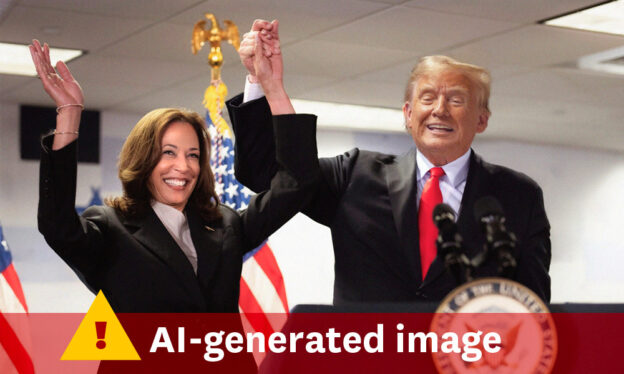
The very first images of Venezuelan president Nicolás Maduro being arrested by U.S. forces were AI-generated fakes. When President Trump shared an actual photo depicting Mr. Maduro in handcuffs and a blindfold, social media users and journalists weren’t sure it was real. A good example of the confusion sown by AI in news reportage.
To be sure, the fake images didn’t misportray what had happened. But there has been true havoc wreaked by less pedestrian imagery.
After federal immigration agents shot and killed two protesters last month in Minneapolis, Democratic Senator Dick Durbin displayed an enlarged photo of an ICE agent holding a gun against the back of the head of one, a man named Alex Pretti, who was down on one knee. It was an AI-altered image. Mr. Pretti was indeed killed in a scuffle but was not, as the photo seemed to show, summarily executed. (To his credit, though, Mr. Durbin, when informed of the provenance of the photo, apologized for inadvertently giving it publicity.)
Another manipulated photo of Mr. Pretti, who was a nurse, enhanced his facial features and portrayed him sympathetically by showing him assisting two rehabilitating veterans.
When, also last month, a group of protesters interrupted a church service in Minnesota, the White House posted a digitally altered image showing one of the demonstrators bawling as she was arrested. It was an AI-altered version of a photo of the woman looking entirely at ease.
The protest was an uncouth disturbance of a religious service. But the photo, still, was sheker.
As were those showing Representative Ilhan Omar smiling next to a man who had sprayed her with apple cider vinegar. That led to claims that the Congresswoman had staged the attack. President Trump echoed the idea on his social media platform.
Needless to say (or maybe not), there was no evidence that the attack, such as it was, was staged. The attacker, moreover, had previously made threats against Ms. Omar and has a history of online criticism against her.
There are more than enough reasons to excoriate Ms. Omar without resorting to sheker.
Then we had an A.I.-generated “newscaster” who reported that California Governor Gavin Newsom had laundered drug money for Mexican cartels. The “report” was reposted on President Trump’s Truth Social platform. And was, in case you might be wondering, entirely evidence-free.
Last October, an entirely convincing video showed a television reporter interviewing a Georgia woman about how she sold her food stamps for cash, which is a crime. The entire conversation was conjured from thin air (and AI). Neither the reporter nor the woman ever existed.
But the reaction to the video was entirely real, with some commenters railing against government assistance programs and others, since the interviewee was black, employing ugly racist tropes.
Fakes have been used to mock not only poor people but President Trump as well. One video showed an image of the White House with a voice-over that sounded exactly like Mr. Trump, berating his cabinet over the release of documents that showed his relationship with a disgraced criminal.
There was a time, a not-too-distant one, when AI-generated “memes” were obviously manufactured, no more misleading than a hand-drawn cartoon. Think the president as Superman or “Dark Brandon” Joe Biden with bright red laser eyes.
They were blatantly, silly caricatures, as anyone could see. Today, though, there are counterfeit images and entire fake videos that are indistinguishable from photos of real things and happenings that actually happened.
And, combined with a polarized, confirmation-biased and disturbingly gullible public, such evolved AI, while it might not spell the end of the human race as some fear, certainly presents an unprecedented challenge to emes.
Social conservatives and liberals alike, have utilized new AI technology to reach and fool the public. But the most aggressive use of AI to mislead seems to have come from one side of the political spectrum. It’s the side whose policies most of us, myself included, favor. But sheker is sheker, and we’re enjoined by the Torah to distance ourselves from it. Here, at least, we’re enjoined to recognize it and certainly to avoid becoming complicit in its dissemination.