Category Archives: Journalism

Muckrakers Not Welcome

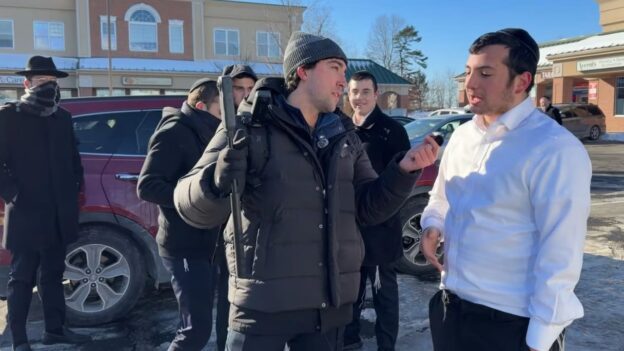
Last month, “activist” Tyler Oliveira notified his eight million social media subscribers that he was planning a trip to the Holy Land: “You guys think Israel will let me into the country?”

Shortly thereafter, Diaspora Affairs Minister Amichai Chikli reposted Mr. O.’s words along with a one-word response: “No.”

Mr. Chikli later explained that he was “proud to have denied entry to Israel today to an unfortunate YouTuber who is using the harassment of Jews as a way to get clout on social media.”

And so, fresh from an appearance on “just saying” Tucker Carlson’s innuendo-cast, the self-appointed investigative journalist – who had previously spent time in New Square and Lakewood harassing residents and “exposing” what he called “a parasitic, insulated Jewish community,” “systemic exploitation” of government programs and Orthodox “invasions” of communities, – boarded an El Al plane to Israel and, when it landed, was denied entry to the country.

During his earlier interview with the increasingly creepy Mr. Carlson, Mr. Oliveira recounted his trips to the heavily Orthodox American Jewish communities.

The “entire lifestyle” of Jews in the towns he visited, he said, “is designed to extract and exploit these welfare systems to the maximum degree. It is strategic. It is not happenstance. It is not coincidental. It is by design.”

The design, of course, is that of our nation’s social services, which reflect the citizenry’s democratically-expressed will to aid large families with limited incomes.

An argument can certainly be made – and Mr. Oliveira repeatedly makes it – that the country should not be using tax dollars to help those who face economic challenges that qualify them for things like the Supplemental Nutrition Assistance Program. Social consciences, unfortunately, aren’t universal.

But when someone singles out only one or two racially or religiously identifiable groups (Mr. Oliveira has gone after other minorities, too), the “argument” is exposed as something other than fiscal conservatism. Tellingly, the muckraking crusader doesn’t seem to have made any effort to visit and harass poor white citizens, say, in Appalachia.

And then there is the regurgitation of hoary antisemitic tropes. “Seemingly,” Mr. Oliveira confided in Mr. Carlson, “there are a lot of powerful Jewish people who own significant media enterprises, [and] websites that seem to bend the knee… to [them]. As if Rupert Murdoch, Jeff Bezos and Elon Musk were members of the tribe.

But, leaving aside the darker elements that infect the souls of some right-wing personalities, a question does present itself: Is Israel wise to prevent such people from visiting?

The argument against permitting them entry (and Israel had denied entry in the past as well to various politicians and academics, based on a 2017 law that allows it to refuse proponents of the Boycott, Divestment, Sanctions movement) is straightforward: People who ally themselves with enemies of the country or with policies that would harm it don’t deserve to tread its soil.

What’s more – and in the case of Mr. Oliveira, it’s an entirely reasonable assumption – people ill-disposed to Israel or Jews will only use their visits to seek out yet new excuses for disparagment.

But there is a downside to that approach as well. The very denial of entry itself is sure to be used by the denied to their advantage. “If they have nothing to fear, why don’t they let me in?” they will say. “Must be that they have reason to fear…”

And, dovetailing with that concern to argue for allowing critics entry is the irrepressible Jewish optimism that dares to imagine that even haters, given the opportunity to get to know their targets better, might feel more constrained in the future, maybe even changed by the experience.

I generally opt for such optimism.

But when I witness someone somehow finding fault even with the volunteer police-allied Shomrim, which helps report and prevent crimes against innocent civilians, calling it, as Mr. Oliveira did, a “religious police” – prompting Mr. Carlson to add “Exactly. Essentially like in Saudi Arabia or Iran” – I have to concede that there are eyes just so hopelessly jaundiced that even the freshest snow will register in their eyes as soot and ash.

(c) 2026 Ami Magazine

AI! AI! AI!

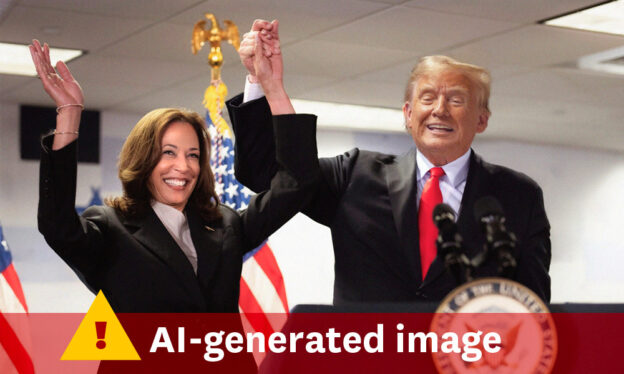
The very first images of Venezuelan president Nicolás Maduro being arrested by U.S. forces were AI-generated fakes. When President Trump shared an actual photo depicting Mr. Maduro in handcuffs and a blindfold, social media users and journalists weren’t sure it was real. A good example of the confusion sown by AI in news reportage.

To be sure, the fake images didn’t misportray what had happened. But there has been true havoc wreaked by less pedestrian imagery.

After federal immigration agents shot and killed two protesters last month in Minneapolis, Democratic Senator Dick Durbin displayed an enlarged photo of an ICE agent holding a gun against the back of the head of one, a man named Alex Pretti, who was down on one knee. It was an AI-altered image. Mr. Pretti was indeed killed in a scuffle but was not, as the photo seemed to show, summarily executed. (To his credit, though, Mr. Durbin, when informed of the provenance of the photo, apologized for inadvertently giving it publicity.)

Another manipulated photo of Mr. Pretti, who was a nurse, enhanced his facial features and portrayed him sympathetically by showing him assisting two rehabilitating veterans.

When, also last month, a group of protesters interrupted a church service in Minnesota, the White House posted a digitally altered image showing one of the demonstrators bawling as she was arrested. It was an AI-altered version of a photo of the woman looking entirely at ease.

The protest was an uncouth disturbance of a religious service. But the photo, still, was sheker.

As were those showing Representative Ilhan Omar smiling next to a man who had sprayed her with apple cider vinegar. That led to claims that the Congresswoman had staged the attack. President Trump echoed the idea on his social media platform.

Needless to say (or maybe not), there was no evidence that the attack, such as it was, was staged. The attacker, moreover, had previously made threats against Ms. Omar and has a history of online criticism against her.

There are more than enough reasons to excoriate Ms. Omar without resorting to sheker.

Then we had an A.I.-generated “newscaster” who reported that California Governor Gavin Newsom had laundered drug money for Mexican cartels. The “report” was reposted on President Trump’s Truth Social platform. And was, in case you might be wondering, entirely evidence-free.

Last October, an entirely convincing video showed a television reporter interviewing a Georgia woman about how she sold her food stamps for cash, which is a crime. The entire conversation was conjured from thin air (and AI). Neither the reporter nor the woman ever existed.

But the reaction to the video was entirely real, with some commenters railing against government assistance programs and others, since the interviewee was black, employing ugly racist tropes.

Fakes have been used to mock not only poor people but President Trump as well. One video showed an image of the White House with a voice-over that sounded exactly like Mr. Trump, berating his cabinet over the release of documents that showed his relationship with a disgraced criminal.

There was a time, a not-too-distant one, when AI-generated “memes” were obviously manufactured, no more misleading than a hand-drawn cartoon. Think the president as Superman or “Dark Brandon” Joe Biden with bright red laser eyes.

They were blatantly, silly caricatures, as anyone could see. Today, though, there are counterfeit images and entire fake videos that are indistinguishable from photos of real things and happenings that actually happened.

And, combined with a polarized, confirmation-biased and disturbingly gullible public, such evolved AI, while it might not spell the end of the human race as some fear, certainly presents an unprecedented challenge to emes.

Social conservatives and liberals alike, have utilized new AI technology to reach and fool the public. But the most aggressive use of AI to mislead seems to have come from one side of the political spectrum. It’s the side whose policies most of us, myself included, favor. But sheker is sheker, and we’re enjoined by the Torah to distance ourselves from it. Here, at least, we’re enjoined to recognize it and certainly to avoid becoming complicit in its dissemination.

FYI

Dear Visitor,

I have started offering weekly writing on the online publishing platform Substack. What I post there are either ruminations that have not been published (or are unpublishable!) elsewhere, some oldies but goodies (at least in my estimation) articles and short thoughts on current events. There is no charge for subscribing.

To subscribe to receive the offerings, just go to https://substack.com/@rabbiavishafran

and click on the “free” option.  There is no need to upgrade to a paying plan (though any funds generated will go to help marbitzei Torah — like funds generated by the “Donate” button here). All of what I post will be accessible to all subscribers.

Last Laugh

It might not be known to many of us, but in the years before WWII, antisemitism of the vilest sort was a prominent part of the American scene.

According to David S. Wyman and Rafael Medoff, in their book “A Race Against Death,” a series of national public opinion polls gauging American attitudes between 1938 and 1946 showed that between one third and one half of the U.S. population saw Jews as greedy and dishonest, and that “Jews had too much power” in the country. Some 15 percent of Americans supported “a widespread campaign against the Jews in this country” and another 20 percent sympathized with such a campaign.

Then there was the infamous German-American Bund, which, on February 20, 1939, some six months before Nazi Germany invaded Poland and just as Hitler was completing construction of his sixth concentration camp, held a packed rally at Madison Square Garden, where more than 20,000 right hands shot forth in the Nazi salute as an American flag passed by. Held aloft were posters with slogans like “Stop Jewish Domination of Christian America.”

Speeches at the rally referred to “job-taking Jewish refugees.” Flags borne by attendees were waved in approval. When an unarmed young Jewish man rushed onstage to protest, he was viciously beaten by attendees before police took him away.

Perhaps most famous of all of the Jew-haters of the time was the Catholic priest Father Charles E. Coughlin. His weekly broadcasts garnered an estimated quarter of the U.S. population at the time. His periodical, “Social Justice,” even printed weekly installments from “Protocols of the Elders of Zion.”

“Yonder comes Father Coughlin wearing the silver chain,” sang folk singer Woody Guthrie, “cash on his stomach and Hitler on the brain.”

Coughlin’s vitriol was so objectionable that he was censured by the hierarchy of the Catholic Church, and the federal government barred his publication “because it mirrored the Axis propoganda line.”

Although he was Canadian-born, by 1926, Coughlin had settled in Detroit, on the order of his superior and avid supporter Bishop Michael J. Gallagher. There he established a parish in the Detroit suburb of Royal Oak, known as the Shrine of the Little Flower. It was from that edifice that he broadcast his views.

In a 1938 speech, he threatened that “When we get through with the Jews of America, they’ll think the treatment they received in Germany was nothing.”

When, on December 5, 1938, Coughlin plagiarized a 1935 speech by Nazi Propaganda Minister Paul Joseph Goebbels, quipsters were quick to refer to Coughlin’s church as “the Shrine of the Little Führer.”

Coughlin died in 1979. He is buried in a Catholic cemetery in Southfield, Michigan.

Southfield is well-known to me. My wife and I have visited the city, and its adjacent city Oak Park, several times. West Bloomfield is another adjacent locale. Two of our dear daughters and their wonderful mishpachos live in that “Greater Detroit” area.

It is a vibrantly Jewish area. Shuls, large and small, abound. There are several kollelim for full time learning including the Kollel Institute of Greater Detroit and Yeshiva Beis Yehuda Kollel.

The city has a respected Vaad HaRabbonim and it operates the local beis din and a kashrus hashgacha division.

There are a number of mosdei chinuch in the area, including the renowned Yeshiva Gedolah of Greater Detroit. There is also Yeshiva Beth Yehudah and its affiliated Bais Yaakov, Yeshiva Darchei Torah, Mesivta of West Bloomfield, the recently opened Yeshivas Ohel Torah-Detroit and others.

And, of course, there is a kosher supermarket and bakeries and eateries. Not to mention Judaica stores and clothing stores aimed at frum clientele. In short, the Orthodox community in “Detroit” (although Southfield, West Bloomfield and Oak Park are really independent cities) is dynamic, strong and growing.

Not far down the road in Southfield lie Coughlin’s bones. Musing on that fact during our most recent visit, I had to smile, imagining what the reverend would have to say about the neighborhood he once called home.

(C) 2025 Ami Magazine