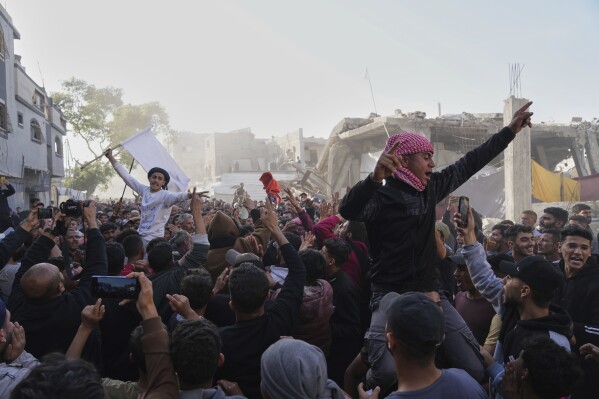
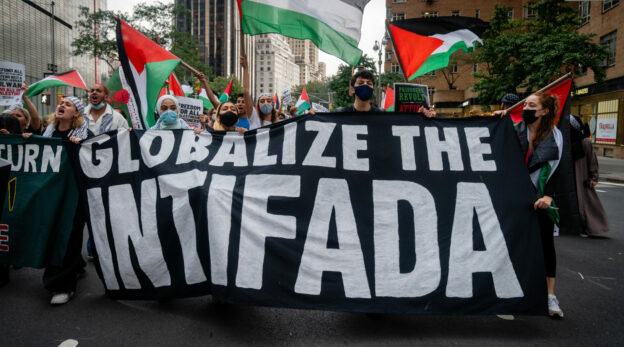
Much of the “pro-Palestinian” (read: anti-Israel—and, more often than not, anti-Jew) activism has been angry, crass, disruptive and destructive.
And, at least in one recent case, counterproductive.
To read about it, click here.

Much of the “pro-Palestinian” (read: anti-Israel—and, more often than not, anti-Jew) activism has been angry, crass, disruptive and destructive.
And, at least in one recent case, counterproductive.
To read about it, click here.

The Catholic Church as an institution has come a long way with regard to its attitude toward the Jewish people. But, apparently, it still has, as they say, a ways to go.
You can read what I mean here:

On a recent Friday night, the Council on American-Islamic Relations (CAIR) held its “30th anniversary gala” in Washington, DC. Too bad you probably missed it.
Something the celebrants didn’t know was that some bad news (at least for them) lay on the horizon. To read what it was, please click here.

With all the wacky wokey warriors spewing hatred for Israel and Jews on college campuses and city streets, one could be forgiven for not noticing the proliferation of anti-Semites on the other end of the political spectrum.
But they’re there, and, in a way, more threatening. You can read about some of them here.

Nations’ annexation of territory, although it tends to cause much clutching of pearls, is not rare.
But the proposed-in-some-circles annexation of Yehudah and Shomron (the “West Bank”) raises an issue that needs to be carefully thought through.
To read what, click here.

In the maelstrom of what passes for political discourse these days, the Jewish imperative of hakaras hatov is too often missing in action. A piece I wrote about the outgoing administration is here.

My lie-dar is well honed; it beeps when my eyes lay upon tendentious falsehoods in media reports.
To read of what set off some recent beeps, please click here.

You can read why here.

We have Tucker Carlson to thank for creating some long-needed pan-partisan unity of late. To read how he managed that, please click here.

From its opening words through many of the parsha’s laws and instructions, Eretz Yisrael is central: Bikkurim, maasros, the settings-up of the Torah-inscribed stones, the brachos and klalos on Har Grizim and Har Eival. The brachos that precede the tochachah are “on the land that Hashem swore to your forefathers, to give you” (Devarim 28:11), and exile from the land is part of the tochachah.
Yet, even as Moshe speaks about Eretz Yisrael, he adds: “Pay attention and listen, Yisrael! This day, you have become a people to Hashem, your G-d” (27:9).
A people. This day.
Comments Rav Shamshon Refael Hirsch:
“Today, before you get the impending possession of the Land, the possession of the Torah is what makes you into a nation. You can lose the land, as indeed you may, but the Torah, and your everlasting duty to it, remains your everlasting unloseable bond which united you as a nation.
“This fundamental fact, deeply buried in Yisrael’s being, differentiates it sharply from that way all other nations have been formed, the secret of the national immortality of the Jews, with all the consequences for Israel’s future that are attached to it.”
That echoes Rav Saadia Gaon’s declaration: “Our nation is only a nation through its Torah.”
It’s a timely thought, when the Jewish presence in Eretz Yisrael is threatened from multiple directions. A merit for preserving the safety and security of Klal Yisrael in Eretz Yisrael lies in commitment to what makes us a nation.
Rav Levi Yitzchok of Berditchev noted how the assurance that “the peoples of the earth… will fear you” (Devarim 28:10), which R’ Eliezer Hagadol ties to our wearing “tefillin shebirosh” (Berachos 6a), doesn’t seem to work.
He explained that shebirosh isn’t the same as al harosh. It isn’t the fact of wearing tefillin that protects us from our enemies. It is our internalization of the words and message that inhabits the tefillin. It has to penetrate “into our heads.”
© 2024 Rabbi Avi Shafran