Category Archives: Jewish Thought

Golden Silence

The mother was understandably concerned.  Her first-grader was a sociable, talkative little girl, and so her teacher’s phone call was certainly disturbing.

This is a true story and took place mere weeks ago in an “out-of-town” community.  The teacher, who called just after school had adjourned, recounted how “Leah,” six years old, had seemed ill at ease the entire afternoon.  In the morning all had seemed well.  But later in the day, although Leah seemed attentive, she was uncharacteristically quiet.  So quiet, indeed, the teacher said, that her little student wouldn’t even respond to questions or as much as open her mouth in class.  That was very unusual.

Leah’s mother, herself a long-time teacher and someone who, along with her kollelman husband, had wonderfully guided their older children through early childhood, had never before received such a phone call.  She was worried, but knew she couldn’t substantively respond to the report before seeing and speaking to Leah herself, and so, with her little one expected home any minute, she thanked the teacher for the “heads up,” and waited for Leah’s arrival.

The teacher, it turned out, had not been imagining things.  Leah walked into the house silently, and just retired to the couch, looking uncomfortable.  She wouldn’t respond to her mother’s “How was school?” or her subsequent “Is everything alright?”

“If you don’t want to tell me what’s wrong” her wise and gentle mother whispered to her daughter, a precocious child who, even at her tender age, can write full sentences, “Can you write down what’s bothering you?”  Leah nodded yes.

Pencil and paper in hand, the girl scribbled away.  At lunchtime, she wrote out, she had washed her hands and made the brachah for netilas yadayim.  But, then, when she went to her lunchbox, the sandwich she had expected to be there wasn’t!  So, she explained, she wasn’t able to speak.

The first feeling that washed over her mother, as one might expect, was relief.  Then, after giving Leah a piece of bread on which to make her Hamotzi, she felt pride.

Had Leah been a bit less bashful, she could have hinted to her quandary, or written a note about it, to someone at school and been given some bread.  Had she realized that speaking after washing for something pertinent to eating is permitted, she could have solved her problem by just telling her teacher about it.

But, being self-conscious and not knowing that halachic fact, she just chose to do what she felt she had to do to be a good Jew.  When the teacher was informed of what had happened, she was deeply impressed.  Ditto for me when I heard the story.

We adults often face difficult situations where halachic concerns come up against personal “needs.”  We seek, and often find, ways of satisfying both.  And then, of course, there are times when there is no seeming reconciliation of the two.  What do we do then?  Hopefully, the right thing.  Leah thought she faced an at least temporarily irreconcilable pair of challenges – wanting to talk but assuming it would be halachically wrong – and, to the best of her understanding, did the right thing.  She thereby became a teacher herself.

Dovid Hamelech sang to Hashem that “Out of the mouths of babes and sucklings You have established strength…” (Tehillim, 8:3).

The straightforward p’shat of that passuk is, as per Metzudos Dovid, that the miracle of a human baby and his latent power of speech demonstrates Hashem’s “strength,” or power.

The Gemara (Sotah, 30b) applies the words to how, when our ancestors emerged from the Yam Suf and Hashem’s presence was manifest, even babies and sucklings declared “This is my G-d and I will glorify Him!”

Also implied by Dovid Hamelech’s words is that, as Resh Lakish in the name of Rav Yehudah Nesiah teaches us (Shabbos 119b), the world only perseveres because of the hevel shel tinokos shel beis rabban, “the mouth-breath of the youngsters in their places of study.”

That is usually understood to mean that Torah studied by the purest of souls, children, keeps the universe going.  And that is certainly true.

But I’ve often wondered at the word hevel, “mouth-breath.”  “Hevel,” in other contexts, means “nothingness.”

The story of Leah’s silence, though, makes me wonder if, perhaps, there are times when even a child’s silence, when it’s an example of how a Jew should see his obligations, can itself be a foundation of Creation.

© 2016 Hamodia

Handling Success With Care

Back in 1941 (no, I don’t remember it personally, but it’s documented), there was an American Jewish establishment group called the “Joint Boycott Council.”  It objected vehemently to Agudath Israel of America’s policy of sending packages of food and religious items to beleaguered and endangered Jews behind enemy lines in Eastern Europe.  The JBC considered that effort an affront to its own judgment that the risk that the Nazis, ym”s, might intercept the goods outweighed what Gedolim of the time considered to be the Jewish obligation.

The group picketed Agudath Israel’s offices that year and its chairman described the Agudah as “a sickly weed transplanted from foreign soil to the liberal American environment,” lamenting how it, and presumably the Orthodox Jewish community it served, will only “continue to poison the atmosphere.”

The Council is now long forgotten, but my, how the “sickly weed” has grown.  The Torah-true community in America proved itself not only hardy but a towering tree that bore, and continues to bear, most wondrous fruit.

Those of us born well after 1941 often take the thriving of Torah life and study for granted.  We hear about the challenges our parents and grandparents faced in the previous century, celebrate their accomplishments and feel secure in the world they forged for us.  That’s not a problem, of course… at least not until it is.

Case in point: Several suburban frum communities are expanding greatly these days, attracting Torah Jews from near and far.  The law of supply and demand won’t be violated, and what ensues are increased property values and willingness, on the part of some long-time homeowners, to “trade up” to larger homes in other areas.

That’s fine and good; and so is the effort by real estate agents to make the case to residents of such communities that they can benefit financially from the new desirability of their dwellings by putting their houses on the market.

What isn’t fine and good, though, is pressuring residents by visiting them, unbidden, to make that case.  And what’s even less fine and good is doing so on non-Jewish holidays, when residents are be more likely to be home but are undoubtedly more likely to resent uninvited guests.

Such solicitations have caused some towns, including Toms River, New Jersey, to update their “no-knock” rules and related laws, adding real estate inquiries to measures that already limit other types of solicitations.

An Associated Press story about that particular New Jersey town was recently widely published by media here and overseas.  It may be a local story, but when an item involves Jews, money and irate neighbors, it somehow tends to… hold… special interest.

The news article quoted one Toms River resident who claimed to have been badgered by an aggressive real estate agent to sell his home.  In local media, several others complained about feeling pressured by Orthodox Jews’ overtures.  The fact that a “no-knock” ordinance was unanimously endorsed by the local Township Council itself indicates that others had, or feared, similar experiences – and should be a wake-up call to us all.

Yes, to be sure, some of the pushback against the pushiness might be tainted with pre-existing resentment of Jews.  But that’s really beside the point. In fact, it intensifies the point.  Because acting in ways that give people who don’t like Jews in the first place reason to resent us, aside from being wrong, well, gives some people who don’t like Jews in the first place reason to resent us.

There is no doubt that the great majority of frum real estate professionals in Lakewood and elsewhere hew to high standards and promote their services in proper manners, using advertisements and mailings. But the small number (it may in fact be only one, but that’s one too many) who feel that it’s “just business” to be aggressive and intimidating toward potential clients are causing ill will against the entire community.  What’s more, they are ketanei emunah.

Because if they believed, as Jews should, that their parnassah comes from Above, and that our efforts to make our livings are entirely in the realm of hishtadlus, “simple, normal effort,” they would never imagine that acting more aggressively than others in their field could yield them some advantage or anything more than what was decreed for them in Shamayim on Rosh Hashanah.

And they should know, too, that the truest measure of Jewish success is acting “with pleasantness toward others,” in ways that make others say “Fortunate is his father who taught him Torah” (Yoma 86a).

© 2016 Hamodia

Voting Advice

Few things outrage people as greatly as the suggestion that their vote doesn’t really make a difference.  “Your vote counts!” is, after all, the essence of Civics 101.

And yet it is the most straightforward of truisms that – other than, say, a vote for gabbai in a very small shul – no election is ever decided on one vote.  Or, in national politics, many thousands.

“But if everyone thought that way, no one would vote!” comes the immediate, irritated reply.

True.  But an observation isn’t an argument.  The bottom line remains that… well, you know.

Please don’t misunderstand.  It is important to vote, and each of us should make every effort to do so, for several reasons.  Firstly, it’s a privilege of citizenship, and seizing it is a sign of respect for the wonderful country in which we live.  Secondly, as observant Jews, with particular needs and interests, it is vital that we be perceived as voters, not as complacent, unengaged citizens.  What’s more, if we live, as many of us do, in fairly homogenous voting districts, elected officials take note of our voting turnouts, and that can influence decisions they make about things that matter to us.

But all of that is in the realm of hishtadlus – appropriate efforts to effect proper goals.  The bottom line remains: our individual votes don’t really count.  (Sorry.)

Is there any point to revealing how we are being brash to imagine our individual votes as crucial, any tachlis to bringing up the shocking reality that they are not?  I believe there is, and that it’s important and timely.

Because too many of us tend to get very – how shall we put it? – agitated over politics.  Should someone dare support what we feel is the “wrong” candidate, or take a “misguided” position on an issue, he isn’t just mistaken; he has become the enemy!

Politics has become, even, lamentably within parts of our community, something akin to what soccer is in some European and Middle Eastern countries: an utterly overheated choosing of teams, followed by zealous, uncompromising rooting, and vilification of those who dare support other teams.  People have been injured and even killed as a result of “football hooliganism,” and fans of opposing teams are routinely segregated in stadium stands, to minimize the likelihood of carnage.

We may not express our political sureties and affiliations with the sort of violence that accompanies some soccer matches.  But, from a Jewish perspective, words can be instruments of violence, too.  And, in a way, worse ones than bats and rocks.

Is getting angry over politics in keeping with Torah values?  With mentchlichkeit?  With reason?

“Just as people’s faces all differ,” we are taught by Chazal, “so do their opinions” (Bamidbar Rabbah,  21:2).

The Imrei Emes, zy”a, commented on that truth with a question: “Can you imagine disdaining someone because his face doesn’t look like yours?”  The question’s implied lesson is obvious: Neither does a person deserve contempt for having a different view of things from yours.  His eyes are a different color from yours; his mind isn’t the same as yours either.

Maybe stopping and thinking about the fact that a vote is only a vote, and that an election’s outcome will not hinge on our ballot, can help us turn down the volume a bit, not to mention lower our blood pressure.

There’s nothing wrong with having political points of view, with discussing national and international issues.  But there is something very wrong about allowing opinions to ferment into anger or resentment.  Choose positions and candidates.  Just don’t overinvest your choices with an importance they simply don’t have.

One of my brothers-in-law once told me, with a sly smile, that, in his house, he makes “the big decisions” and leaves the “small ones” to his wife.  He then explained that he decides what should be done about world affairs, the economy, immigration and crime; his wife takes care of raising the children, chinuch matters, the atmosphere in the home…

In fact, if we want to do something to influence world affairs, we do well to remind ourselves that lev melech bi’yad Hashem (Mishlei 21:1) that, in the end, it’s the Bashefer, not the ballot box. Our power lies in choosing how to live, not how to vote.  Deciding to daven more mindfully, to learn more seriously, to engage in chessed more frequently – those are the choices that count.

© 2016 Hamodia

Error Message

Is it permissible to drink water on Shabbos?

Yes, the question is facetious.  But not pointless.  Because the parshiyos of this time of year, which deal with the construction of the mishkan and its vessels, are the source of what constitutes a melachah, or act forbidden on Shabbos. (That connection is based on the juxtaposition of the Torah account of the building of the mishkan and the law of Shabbos.)

Still wondering about the opening sentence?  Well, if every act done during the mishkan’s building constitutes a melachah, isn’t it reasonable to imagine that those engaged in the construction occasionally drank some water?

That’s ridiculous, you protest, rightly.  Drinking isn’t essential for building the mishkan!

You’re right.  Neither, though – at least at first thought – is making a mistake.

And Chazal assume as a matter of course that mistakes were made during the mishkan’s construction.  That is why the mishnah in Masseches Shabbos (73a) includes mocheik, or “erasing,” the sister-melachah of “writing.”

Writing was used in the hakamas hamishkan, the Gemara explains, (ibid, 103b) to ensure that the kerashim, the gilded wooden beams used for the structure – which was dismantled and rebuilt repeatedly – were inscribed with letters to indicate which beams were to be placed where.

And Rashi, on the mishnah preceding that Gemara, explains that the melachah of erasing derives from the need to correct errors when the wrong letters were mistakenly inscribed on beams.

Now, if drinking water isn’t a melachah because it was not intrinsic to the construction project, why should the correcting of a mistake, namely, erasing, be a melacha?  Making mistakes isn’t intrinsic to the project… or is it?

But when one thinks deeply about errors, one comes to realize that they are in fact essential parts of success.  Even when it comes to Torah-study, about which the Gemara says (Gittin, 43a), “[When it comes to words of Torah] one does not stand on [i.e. understand] them unless one [first] stumbles over them.”  Every talmid of Talmud knows that well; there is no understanding like that which dawns after having made a wrong assumption.

In fact, mistakes are indispensable parts of even mundane projects, educational or otherwise.  No child walks until he first takes an uneasy step and falls.  The eventual ability to walk doesn’t come despite the first unsuccessful attempts; it comes as a result of them.

Even when it comes to more complex things like engineering, the path to success leads through a maze of mistakes.  Duke University civil engineering professor Henry Petroski captured that truth in the title of one of his books: “To Engineer is Human: The Role of Failure in Successful Design.” Initial failures, he asserts in that book, are what drive any task to perfection.

“An expert,” the famous Jewish physicist Neils Bohr once remarked, “is a man who has made all the mistakes which can be made in a very narrow field.”

The importance of erring informs many areas of life.  When I was privileged to serve as a rebbe teaching Gemara, when a talmid would ask what some call a “klutz kasha” – a question based on a misunderstanding, my reaction (at least when I had my wits about me) was, “Wow!  You made a great mistake!”  And then I would proceed to show how that mistaken assumption clearly led to the question asked, but that it was mistaken, and thus a vital part of the process of truly understanding the subject at hand.

I didn’t call the talmid’s mistake “great” to coddle him or boost his self-esteem (though that’s sometimes not a bad idea).  It was an honest assessment.

The world in which we live often seems to embrace an opposite philosophy, where mistakes are often not only unappreciated but not tolerated.  Errors are seen as, at best, embarrassments, not worthy experiences.  Just – for a timely example – note how presidential candidates handle questions about questionable past decisions, dredged up by media intent on uncovering clay feet.

The pols hem and haw, they justify and deny, they “explain” and, if at all possible, just change the subject.  How refreshing it would be were one or two of them to discard the political script and say something radical, shocking and outrageous, like “It was a mistake.  I erred and, hopefully, came away from my error wiser.”  A perceptive fellow once said that “Admitting a mistake only means you’re smarter than you were yesterday.”

Let’s not raise politicians.  Our children, grandchildren and talmidim need to know that to err is not just human, it’s vital.

© 2016 Hamodia

The American Jewish Buffet

“Secular Orthodox.”

That’s how Avinoam Bar-Yosef, president of the Jewish People Policy Planning Institute, recently characterized many Israelis.  What he meant was that, while an Israeli may not be observant of halachah, or even affirm belief in Torah miSinai, he is likely to still recognize that there is only one mesorah, one Judaism, the one that has carried Klal Yisrael from that mountain to Eretz Yisrael, through galus Bavel and countless galuyos since, and that carries it still to this day.

If only American Jews were so perceptive.  Many criticisms can be cogently aimed at the movements to which so many American Jews claim fealty (or, at least, to whose congregations they send dues).  Were there only an Orthodox option, that of Torah-faithful belief and practice, there would likely be a greater degree of Jewish observance throughout the broader Jewish community; intermarriage would probably be more rare than it sadly is; Jewish unity would certainly be more evident, and more real.

But the most damaging legacy of the heterodox movements (and I write here of those movements qua movements – their theologies, not their members, most of whom don’t understand the basics of Yahadus) is their propagation of the notion that there are different “Judaisms,” that Jews stand before some spiritual smorgasbord from which they are free to choose whatever doctrinal hors d’oeuvres they find appetizing.

I had a neighbor in the out-of-town community where I once lived, a middle-aged man who had observed some mitzvos as a youth, but who had long since lapsed and become a member of a non-Orthodox congregation.

One Shabbos, on my way to shul, I heard a disembodied “Good Shabbos” come from beneath my neighbor’s parked car.  His head then appeared from under the vehicle, followed by his hands, one of them holding a wrench.  I returned the greeting along with a forced smile, and then, with some sheepishness, my neighbor added: “I gotta say, my Shabbos is sure different now that I’m a Conservative Jew!”

In my neighbor’s mind, he had undergone a metamorphosis; he’d become a “different kind of Jew” – a perfectly observant, rabbinically-endorsed, card-carrying “Conservative Jew.”  Changing the meaning of a Jewish life had become the equivalent of what he was doing, changing his oil.

Contrast my erstwhile neighbor’s attitude (that of most American Jews, unfortunately) with the insight of Nobel laureate I. I. Rabi (1898-1988), a groundbreaking physicist. He told a biographer that “To this very day, if you ask for my religion, I say ‘Orthodox Hebrew’ – in the sense that the church [sic] I’m not attending is that one.  If I were to go to a church, that’s the one I would go to.   That’s the one I failed.  It doesn’t mean I’m something else…”

He was, and knew he was, a Jew.  Far to one side of the observance spectrum, to be sure.  But observance is a continuum on which we all live, with perfection far from most of us.  Professor Rabi was perceptive and honest enough to recognize his failure instead of choosing to just invent a new entity, a “Judaism” where he could consider himself a success.

It is a tribute to the Israeli no-nonsense mentality that so many of the country’s less- or non-observant Jews haven’t bought into the American Jewish buffet model, and recognize what Professor Rabi did. Israelis tend to think and talk dugri – straightforwardly, even bluntly.  Hence, Mr. Bar-Yosef’s seemingly, but not really, oxymoronic phrase, “secular Orthodox.”

What evoked that characterization, as it happens, was his interview by the New York Times about the recent Israeli government decision to expand an area to the south of the current Kosel Maaravi plaza, for feminist and non-Orthodox services.  The Israeli was trying to explain why the American Jewish model of Jewish identity has not taken root in his country.  American Jews, he continued, have “a desire to bring into the tent everyone who feels Jewish,” whereas Israeli Jews, even secular ones, “live in a [Jewish] state and want a unified system.”

That “unified system” – halachah –  is, unfortunately, under attack by some American Jews, not only with regard to conduct at the Kosel but in even more important areas, like marriage and geirus.  We have to hope, against all the evidence, that our less observant brothers and sisters recognize the danger – to themselves above all – of promoting a “multi-winged” model of “Judaisms,” instead of recognizing the most trenchant truth: that ke’ish echad was possible only because our ancestors were neged hahar.

© 2016 Hamodia

Agudath Israel Reaction to the “Kotel Compromise”

Designating an area at the Kotel Maaravi for feminist and mixed-gender prayer not only profanes the holy site, it creates yet a further lamentable rift between Jews.

For more than three decades, the Western Wall has been a place – perhaps the only one in the world – where Jews of all affiliations and persuasions have regularly prayed side by side.

What has allowed for that minor miracle has been the maintenance at that holy place of a standard – that of time-honored Jewish religious tradition – that all Jews, even those who might prefer other standards or none at all, can abide.

If the current plan is in fact realized, that will be no more.

Instead, there will be two options: some Jews at the Wall will pray at a space whose atmosphere respects and reflects traditional Jewish prayer, and others at a space that doesn’t.

Illogical Leadership

“Because you were convincing me,” was the woman’s straightforward reply.

Her questioner was my rebbe, Rav Yaakov Weinberg, zt”l, then the Rosh Yeshivah of Yeshivas Ner Yisrael in Baltimore.  He had asked the lady, whom he met at some Jewish communal function, why she had suddenly stopped attending the lecture series he had been delivering to a nonreligious audience.  Rav Weinberg later said that he was struck by the stark honesty of the reply.  No excuses, no claim of scheduling conflict, only a candid confession of her reluctance to be pulled in a direction that frightened her.

The lectures were about basic Jewish belief, and the Rosh Yeshivah combined concepts from the Rambam, Rav Yehudah HaLevi and others, leavened with his own insight, eloquence, humor and creativity, to describe the compelling specialness – indeed, singularity – of the Jewish mesorah.

There was the historically unparalleled claim to a mass revelation at Har Sinai, something that no one could dare make unless it happened – and that no nation or religion has in fact ever made, before or after the event.   There was the seemingly self-defeating nature of some of the Torah’s laws, like Shemitta and Aliyah L’regel (when all able-bodied men left Eretz Yisrael’s borders unprotected, at easily predictable times).  There were the Torah’s critical descriptions of its greatest personages, in such stark contrast to the perfect “heroes” of other groups’ “holy” books.  There was the utterly irrational persistence of anti-Semitism in a broad, even contradictory, assortment of guises; and the perseverance of Klal Yisrael despite all the hatred and exiles.

And then there was the illogical leadership of Moshe Rabbeinu, detailed in the parshiyos we are reading communally in shul this time of year.

Over history, leaders – religious and political alike – tend to possess all or most of several defining characteristics.  Almost by definition, they are ambitious and opportunistic, often aggressively so.  They exude self-confidence, bordering on, if not exceeding, conceit; and they are natural orators.

Moshe Rabbeinu, Rav Weinberg would point out, had none of those characteristics.  He didn’t want the role Hashem told him to adopt, pleading that his brother Aharon be appointed instead.  He was, by the Torah’s testimony, not only modest but the most modest of all men.  And he was, by his own statement, limited in his ability to speak.

Not, by nature, leader material. Other religion-forming figures, by contrast, possessed the natural ability to convince others of their purported connection to truth – and capitalized on it vigorously.  Today, political leaders and aspirants to office, as we are witnessing most vividly during this presidential election year, are clearly saturated with self-regard, relentlessly self-promoting and accomplished in the art of speechifying.

Moshe’s lack of those traits didn’t matter, because his leadership was not the result of popular acclaim but rather of Divine direction. Indeed, his failure of the “leadership test” is evidence of that fact. No one, Rav Weinberg explained, could ever attribute the historic success of the Jewish message to the impact of charisma, self-confidence or oratorical skill.  Only to G-dly guidance.

Only defective products need talented salesmen.  Truth needs only itself.

Chazal (Berachos 58a) tell us to run to see a non-Jewish king, for if we are deemed worthy, we will be able to perceive the difference between a non-Jewish monarch and a Jewish one.  Politicians aren’t kings; there are no brachos to be made over them.  But there is certainly worth in pondering the gulf between what contemporary society calls leadership and a true, Divinely appointed, leader.

I don’t know at what point the woman who dropped out of the lecture series decided she had heard too much for comfort. It was probably before the “Moshe Rabbeinu” shiur.  But she was perceptive enough to realize that the evidence for the truth of the Jewish mesorah was becoming overwhelming, that the thicket of rationalizations necessary for rejecting the compelling facts of history was obscuring a more compelling straightforward, Occam’s Razor-respecting, conclusion: Moshe emes visoraso emes.

And she just wasn’t ready to countenance the life-changing implications of that fact.

At least at that point.  I like to imagine that, one day, she wandered into a shul somewhere this time of year, maybe even during an election campaign, and, during krias haTorah, followed along in an English translation and was struck by Moshe Rabbeinu’s “lack of qualifications” for leadership, as the word is mundanely defined.  And that maybe, at that point, what she didn’t allow herself to hear from Rav Weinberg, she heard in her own head.

© 2016 Hamodia

A Crying Shame

Readers of a certain age will likely recognize the name Edmund Muskie.  He was a candidate for the Democratic Party nomination for President back in 1972.

There were several reasons why the candidacy of the former Maine governor, senator and Secretary of State was curtailed.  Rumors were spread that he was a drug addict. The Manchester Union-Leader asserted that his wife was an alcoholic and bad-mannered, and that Muskie had made disparaging remarks about French-Canadians.

It emerged later that the latter rumor was a fabrication, part of Richard Nixon’s infamous “dirty tricks” strategy to harm political enemies.  But damage had been done, and Muskie’s reaction to the negative characterizations of his wife was widely regarded as coup de grâce for his campaign.

Standing before reporters outside the newspaper’s offices on a snowy February day in 1972, he emotionally defended his wife.  And, at one point, shed tears.

He later claimed that, while he was indeed upset, the droplets on his face were merely melted snowflakes.

No one will ever know.  Mr. Muskie died in 1996 and videos of the incident are inconclusive.  One thing, though, is clear: The idea of a president capable of crying seemed shameful to the American electorate in 1972.

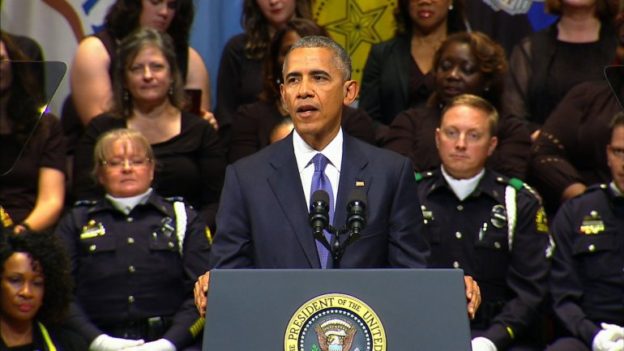
Contrast that with the public reaction to the current Crier-in-Chief.  Mr. Obama has not held back from weeping on several occasions, including memorial services and as he presented military awards.  And, most recently, when he announced an executive order expanding the scope of background checks on gun buyers and increasing funding for mental health treatment (actions that, amazingly, raised howls of protest from some – but that’s a different article).  In the presence of family members of gun fatalities, he choked up as he recalled the children murdered in the Sandy Hook elementary school shooting.

The usual suspects, of course, intent on seeing only cold, diabolical evil in Obama, immediately took to social media to share theories about how the president had managed to conjure his obviously (at least to the commenters) fake tears.  The thought that he was sincerely distraught at the memory of small schoolchildren’s bodies riddled with bullets just could not be entertained, at any cost.

Saner Americans readily accepted that the president’s tears were sincere. Some found the tears laudable, evidence of his humanity.  Others found them telling, evidencing the president’s frustration over fighting a gun lobby that insists that, unlike other fundamental rights like free speech and assembly, the Second Amendment must be unlimited. Others just found the crying unremarkable.

We’ve come a long way.

No one these days seems to see a president sincerely tearing up as scandalous.  What to make of that?  Is it evidence to the “wimping down” of America?  An emotional counterpart to the moral decline of a once-great nation?

Or, perhaps, a sign of its maturity?

In some ways, American society has indeed grown more advanced.  It is, for instance, no longer as riven with overt racism and anti-Semitism as once it was (even if individual anti-Semitic acts are far from rare even today).  The idea that parents are the best arbiters of their children’s educational environments has become enshrined in law and widely accepted (if not yet widely taken to its logical legislative conclusion). The distance traveled since Mr. Muskie’s day regarding leaders’ public emoting may be another sign of America’s positive growth.

Leaving the hidden onion-juice conspiracy theorists aside (where they belong), sincere crying is not dishonorable.  Emotions, and the tears that accompany their most intense states, are the hallmark of a developed human being. Your GPS guide doesn’t cry.  Nazis don’t cry.  Terrorists don’t cry.

By contrast, we Jews are known for our tears.  It may have been wrong for our ancestors to cry out of fear when they first stood at the cusp of entering Eretz Yisrael.  But that bechiyah shel chinam, “unwarranted crying,” is atoned for by our own tears, on Tisha B’Av, on Yom Kippur, at Tikkun Chatzos…  The Kosel Maaravi is saltily stained with the sobbing of countless Jewish generations.

Our forefather Yaakov cried.  So did Yosef, and Moshe Rabbeinu.  Rachel Imeinu cries still.  The Cohen Gadol cried, as did tanna’im.  Even Hashem, kivayachol, is described as crying (Chagigah, 5b).

So, whether or not larger society’s having come to accept that even a leader is not lesser for lachrymosity is something positive, Jewish weeping for the right reasons most certainly is.

May it lead, and soon, to the end of all crying, to the fulfillment of Yeshayahu’s nevuah (25:8) that Hashem “will wipe tears from every face.”

© 2016 Hamodia

From the Mouths of Mexicans

I’ll call him Pedro; maybe it’s even his name.  He seems to be a custodian of some sort for a shul – though I have no idea where it might be.  He wears a worn tee-shirt and speaks English haltingly; it’s hard to understand all his words in the short video a friend received from someone else and shared with me. I don’t know, or much care, whether or not Pedro’s a legal immigrant. What I know is that he has something important to say.

I’ll share his words below, but first, a word from the Sdei Chemed (Maareches Beis Haknesses, 21).  Citing the Magen Avraham and the Chasam Sofer, Rav Chaim Chizkiya Medini concludes that any behavior considered disrespectful in a given society’s non-Jewish houses of worship becomes, as a result, forbidden in that society’s Jewish shuls. Even actions that are otherwise permitted by halachah in a shul, if they are regarded as disrespectful in local places of non-Jewish worship, are forbidden in a Jewish makom tefillah.

That’s something well worth pondering these days.  There may be churches where congregants “warm up” in the chapel as services get underway by loudly discussing politics, business or the stock market, or just joking around.

My guess, though, is that there aren’t many.

Klal Yisrael is blessed, baruch Hashem, with shuls where proper decorum is the norm, that mispallelim enter with reverence and use only for davening and learning Torah. But, as we all know, there are many, too, that seem less of a mikdash me’at than a shuk gadol.

I understand, I really do, that shuls are seen as “home” by many Jews.  As they should be, at least to an extent.  After all, we spend good parts of our lives within their walls.  We feel comfortable there.

But even a shul that was built – as most shuls are today – on the condition that eating and drinking will take place in it nevertheless remains a shul, and the condition made does not permit any less respectful behavior.

And when davening itself is taking place, the ante is upped considerably.  Then it is not just the place that is holy but the time.  Anyone who has learned the halachos of tefillah knows the parts of davening when mundane conversation is forbidden – and they include chazaras hashatz.  Those halachos are in the same Shulchan Aruch as the laws of taaruvos and Shabbos.  (And anyone possessed of common sense knows that even at times when talking may be permitted, if it disturbs others’ prayers, it is a violation of simple human courtesy.)

I write here about decorum, not quiet.  There is nothing wrong, and indeed everything right, about saying Pesukei d’Zimrah and Krias Shma aloud.  That’s what some of our non-Jewish neighbors refer to as “making a joyful noise” to Hashem, their translation of “hari’u l laHashem kol haaretz,” the first passuk of Tehillim 100.

But if the noise isn’t joyful, and not laHashem, then it’s just noise.

Davening demands dignity.  A stranger to many a shul would surely be impressed by what he sees.  But there are, reportedly, shuls where the stranger would be puzzled, where he would wonder at how worshippers could purposefully leave their phones on during services, allowing the devices to interrupt the proceedings with ringing and beeping and singing.  Where those gathered for prayer actually answer their phones, or tap out text messages and e-mails.

Which brings us to Pedro.  He has clearly not rehearsed his words, only observed something that bothers him.  He smiles sheepishly at times but is determined to share his message, presumably with someone to whom he complained, and who then asked him to speak on camera. I quote the custodian verbatim:

Me no understand.  When they come to the synagogue – fifteen minutes, twenty minutes, thirty minutes, one hour, whatever – it’s for the G-d.  Not for the phone…  Oh, somebody call?  ‘Oh, wait G-d!  Somebody call me…’ 

NO! Come for the synagogue.  It’s for the G-d.  Close the phone or something or not pick up the phone.  No phone.  Me, I don’t understand.  I like them for the praying, three, four times a day. It’s good.  But no like them when they pick up the phone.  It’s no good.  For me, it’s no good…

For us, too, it should be no good.

© 2016 Hamodia