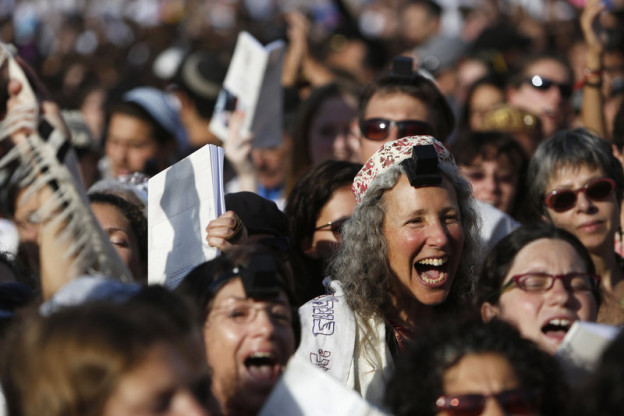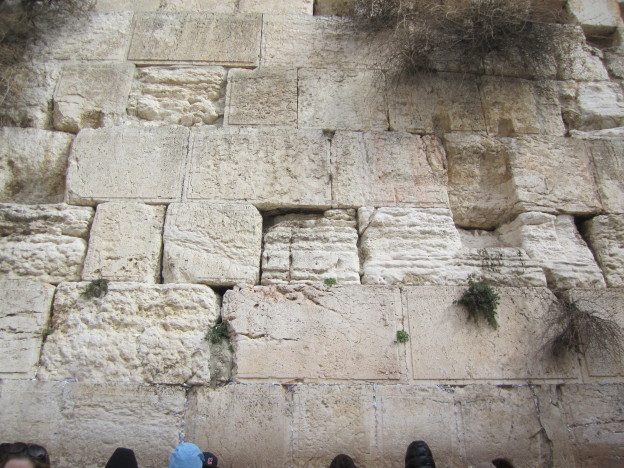
Many are celebrating the official setting aside and expansion of a part of the Kotel Maaravi for non-traditional public prayer. I’m not among them.
My thoughts on the matter are in the Forward today. You can read them here.

Many are celebrating the official setting aside and expansion of a part of the Kotel Maaravi for non-traditional public prayer. I’m not among them.
My thoughts on the matter are in the Forward today. You can read them here.

Designating an area at the Kotel Maaravi for feminist and mixed-gender prayer not only profanes the holy site, it creates yet a further lamentable rift between Jews.
For more than three decades, the Western Wall has been a place – perhaps the only one in the world – where Jews of all affiliations and persuasions have regularly prayed side by side.
What has allowed for that minor miracle has been the maintenance at that holy place of a standard – that of time-honored Jewish religious tradition – that all Jews, even those who might prefer other standards or none at all, can abide.
If the current plan is in fact realized, that will be no more.
Instead, there will be two options: some Jews at the Wall will pray at a space whose atmosphere respects and reflects traditional Jewish prayer, and others at a space that doesn’t.

“Because you were convincing me,” was the woman’s straightforward reply.
Her questioner was my rebbe, Rav Yaakov Weinberg, zt”l, then the Rosh Yeshivah of Yeshivas Ner Yisrael in Baltimore. He had asked the lady, whom he met at some Jewish communal function, why she had suddenly stopped attending the lecture series he had been delivering to a nonreligious audience. Rav Weinberg later said that he was struck by the stark honesty of the reply. No excuses, no claim of scheduling conflict, only a candid confession of her reluctance to be pulled in a direction that frightened her.
The lectures were about basic Jewish belief, and the Rosh Yeshivah combined concepts from the Rambam, Rav Yehudah HaLevi and others, leavened with his own insight, eloquence, humor and creativity, to describe the compelling specialness – indeed, singularity – of the Jewish mesorah.
There was the historically unparalleled claim to a mass revelation at Har Sinai, something that no one could dare make unless it happened – and that no nation or religion has in fact ever made, before or after the event. There was the seemingly self-defeating nature of some of the Torah’s laws, like Shemitta and Aliyah L’regel (when all able-bodied men left Eretz Yisrael’s borders unprotected, at easily predictable times). There were the Torah’s critical descriptions of its greatest personages, in such stark contrast to the perfect “heroes” of other groups’ “holy” books. There was the utterly irrational persistence of anti-Semitism in a broad, even contradictory, assortment of guises; and the perseverance of Klal Yisrael despite all the hatred and exiles.
And then there was the illogical leadership of Moshe Rabbeinu, detailed in the parshiyos we are reading communally in shul this time of year.
Over history, leaders – religious and political alike – tend to possess all or most of several defining characteristics. Almost by definition, they are ambitious and opportunistic, often aggressively so. They exude self-confidence, bordering on, if not exceeding, conceit; and they are natural orators.
Moshe Rabbeinu, Rav Weinberg would point out, had none of those characteristics. He didn’t want the role Hashem told him to adopt, pleading that his brother Aharon be appointed instead. He was, by the Torah’s testimony, not only modest but the most modest of all men. And he was, by his own statement, limited in his ability to speak.
Not, by nature, leader material. Other religion-forming figures, by contrast, possessed the natural ability to convince others of their purported connection to truth – and capitalized on it vigorously. Today, political leaders and aspirants to office, as we are witnessing most vividly during this presidential election year, are clearly saturated with self-regard, relentlessly self-promoting and accomplished in the art of speechifying.
Moshe’s lack of those traits didn’t matter, because his leadership was not the result of popular acclaim but rather of Divine direction. Indeed, his failure of the “leadership test” is evidence of that fact. No one, Rav Weinberg explained, could ever attribute the historic success of the Jewish message to the impact of charisma, self-confidence or oratorical skill. Only to G-dly guidance.
Only defective products need talented salesmen. Truth needs only itself.
Chazal (Berachos 58a) tell us to run to see a non-Jewish king, for if we are deemed worthy, we will be able to perceive the difference between a non-Jewish monarch and a Jewish one. Politicians aren’t kings; there are no brachos to be made over them. But there is certainly worth in pondering the gulf between what contemporary society calls leadership and a true, Divinely appointed, leader.
I don’t know at what point the woman who dropped out of the lecture series decided she had heard too much for comfort. It was probably before the “Moshe Rabbeinu” shiur. But she was perceptive enough to realize that the evidence for the truth of the Jewish mesorah was becoming overwhelming, that the thicket of rationalizations necessary for rejecting the compelling facts of history was obscuring a more compelling straightforward, Occam’s Razor-respecting, conclusion: Moshe emes visoraso emes.
And she just wasn’t ready to countenance the life-changing implications of that fact.
At least at that point. I like to imagine that, one day, she wandered into a shul somewhere this time of year, maybe even during an election campaign, and, during krias haTorah, followed along in an English translation and was struck by Moshe Rabbeinu’s “lack of qualifications” for leadership, as the word is mundanely defined. And that maybe, at that point, what she didn’t allow herself to hear from Rav Weinberg, she heard in her own head.
© 2016 Hamodia

Readers of a certain age will likely recognize the name Edmund Muskie. He was a candidate for the Democratic Party nomination for President back in 1972.
There were several reasons why the candidacy of the former Maine governor, senator and Secretary of State was curtailed. Rumors were spread that he was a drug addict. The Manchester Union-Leader asserted that his wife was an alcoholic and bad-mannered, and that Muskie had made disparaging remarks about French-Canadians.
It emerged later that the latter rumor was a fabrication, part of Richard Nixon’s infamous “dirty tricks” strategy to harm political enemies. But damage had been done, and Muskie’s reaction to the negative characterizations of his wife was widely regarded as coup de grâce for his campaign.
Standing before reporters outside the newspaper’s offices on a snowy February day in 1972, he emotionally defended his wife. And, at one point, shed tears.
He later claimed that, while he was indeed upset, the droplets on his face were merely melted snowflakes.
No one will ever know. Mr. Muskie died in 1996 and videos of the incident are inconclusive. One thing, though, is clear: The idea of a president capable of crying seemed shameful to the American electorate in 1972.
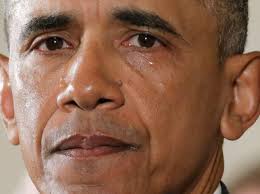
Contrast that with the public reaction to the current Crier-in-Chief. Mr. Obama has not held back from weeping on several occasions, including memorial services and as he presented military awards. And, most recently, when he announced an executive order expanding the scope of background checks on gun buyers and increasing funding for mental health treatment (actions that, amazingly, raised howls of protest from some – but that’s a different article). In the presence of family members of gun fatalities, he choked up as he recalled the children murdered in the Sandy Hook elementary school shooting.
The usual suspects, of course, intent on seeing only cold, diabolical evil in Obama, immediately took to social media to share theories about how the president had managed to conjure his obviously (at least to the commenters) fake tears. The thought that he was sincerely distraught at the memory of small schoolchildren’s bodies riddled with bullets just could not be entertained, at any cost.
Saner Americans readily accepted that the president’s tears were sincere. Some found the tears laudable, evidence of his humanity. Others found them telling, evidencing the president’s frustration over fighting a gun lobby that insists that, unlike other fundamental rights like free speech and assembly, the Second Amendment must be unlimited. Others just found the crying unremarkable.
We’ve come a long way.
No one these days seems to see a president sincerely tearing up as scandalous. What to make of that? Is it evidence to the “wimping down” of America? An emotional counterpart to the moral decline of a once-great nation?
Or, perhaps, a sign of its maturity?
In some ways, American society has indeed grown more advanced. It is, for instance, no longer as riven with overt racism and anti-Semitism as once it was (even if individual anti-Semitic acts are far from rare even today). The idea that parents are the best arbiters of their children’s educational environments has become enshrined in law and widely accepted (if not yet widely taken to its logical legislative conclusion). The distance traveled since Mr. Muskie’s day regarding leaders’ public emoting may be another sign of America’s positive growth.
Leaving the hidden onion-juice conspiracy theorists aside (where they belong), sincere crying is not dishonorable. Emotions, and the tears that accompany their most intense states, are the hallmark of a developed human being. Your GPS guide doesn’t cry. Nazis don’t cry. Terrorists don’t cry.
By contrast, we Jews are known for our tears. It may have been wrong for our ancestors to cry out of fear when they first stood at the cusp of entering Eretz Yisrael. But that bechiyah shel chinam, “unwarranted crying,” is atoned for by our own tears, on Tisha B’Av, on Yom Kippur, at Tikkun Chatzos… The Kosel Maaravi is saltily stained with the sobbing of countless Jewish generations.
Our forefather Yaakov cried. So did Yosef, and Moshe Rabbeinu. Rachel Imeinu cries still. The Cohen Gadol cried, as did tanna’im. Even Hashem, kivayachol, is described as crying (Chagigah, 5b).
So, whether or not larger society’s having come to accept that even a leader is not lesser for lachrymosity is something positive, Jewish weeping for the right reasons most certainly is.
May it lead, and soon, to the end of all crying, to the fulfillment of Yeshayahu’s nevuah (25:8) that Hashem “will wipe tears from every face.”
© 2016 Hamodia

I’ll call him Pedro; maybe it’s even his name. He seems to be a custodian of some sort for a shul – though I have no idea where it might be. He wears a worn tee-shirt and speaks English haltingly; it’s hard to understand all his words in the short video a friend received from someone else and shared with me. I don’t know, or much care, whether or not Pedro’s a legal immigrant. What I know is that he has something important to say.
I’ll share his words below, but first, a word from the Sdei Chemed (Maareches Beis Haknesses, 21). Citing the Magen Avraham and the Chasam Sofer, Rav Chaim Chizkiya Medini concludes that any behavior considered disrespectful in a given society’s non-Jewish houses of worship becomes, as a result, forbidden in that society’s Jewish shuls. Even actions that are otherwise permitted by halachah in a shul, if they are regarded as disrespectful in local places of non-Jewish worship, are forbidden in a Jewish makom tefillah.
That’s something well worth pondering these days. There may be churches where congregants “warm up” in the chapel as services get underway by loudly discussing politics, business or the stock market, or just joking around.
My guess, though, is that there aren’t many.
Klal Yisrael is blessed, baruch Hashem, with shuls where proper decorum is the norm, that mispallelim enter with reverence and use only for davening and learning Torah. But, as we all know, there are many, too, that seem less of a mikdash me’at than a shuk gadol.
I understand, I really do, that shuls are seen as “home” by many Jews. As they should be, at least to an extent. After all, we spend good parts of our lives within their walls. We feel comfortable there.
But even a shul that was built – as most shuls are today – on the condition that eating and drinking will take place in it nevertheless remains a shul, and the condition made does not permit any less respectful behavior.
And when davening itself is taking place, the ante is upped considerably. Then it is not just the place that is holy but the time. Anyone who has learned the halachos of tefillah knows the parts of davening when mundane conversation is forbidden – and they include chazaras hashatz. Those halachos are in the same Shulchan Aruch as the laws of taaruvos and Shabbos. (And anyone possessed of common sense knows that even at times when talking may be permitted, if it disturbs others’ prayers, it is a violation of simple human courtesy.)
I write here about decorum, not quiet. There is nothing wrong, and indeed everything right, about saying Pesukei d’Zimrah and Krias Shma aloud. That’s what some of our non-Jewish neighbors refer to as “making a joyful noise” to Hashem, their translation of “hari’u l laHashem kol haaretz,” the first passuk of Tehillim 100.
But if the noise isn’t joyful, and not laHashem, then it’s just noise.
Davening demands dignity. A stranger to many a shul would surely be impressed by what he sees. But there are, reportedly, shuls where the stranger would be puzzled, where he would wonder at how worshippers could purposefully leave their phones on during services, allowing the devices to interrupt the proceedings with ringing and beeping and singing. Where those gathered for prayer actually answer their phones, or tap out text messages and e-mails.
Which brings us to Pedro. He has clearly not rehearsed his words, only observed something that bothers him. He smiles sheepishly at times but is determined to share his message, presumably with someone to whom he complained, and who then asked him to speak on camera. I quote the custodian verbatim:
“Me no understand. When they come to the synagogue – fifteen minutes, twenty minutes, thirty minutes, one hour, whatever – it’s for the G-d. Not for the phone… Oh, somebody call? ‘Oh, wait G-d! Somebody call me…’
NO! Come for the synagogue. It’s for the G-d. Close the phone or something or not pick up the phone. No phone. Me, I don’t understand. I like them for the praying, three, four times a day. It’s good. But no like them when they pick up the phone. It’s no good. For me, it’s no good…”
For us, too, it should be no good.
© 2016 Hamodia

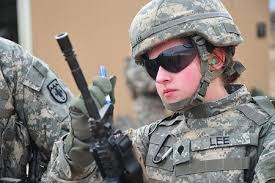
When President Obama called the recent U.S. military announcement that all combat roles will now be open to women a “historic step forward,” the image that came to mind was of someone marching resolutely off a cliff.
There is something alarming in a purely practical sense here. The U.S. military is currently an all-volunteer force, but young men are still required to register in case conscription is reactivated. Will young women now have to follow suit? And, if compulsory service is ever reactivated in the U.S., will women be drafted too?
More immediately troubling, though, is the position implied by the military: that there is no meaningful difference between men and women.
I don’t doubt that women, like men, with proper training, can be effective fighters. But are women soldiers an enlightened expression of a new womanhood, or a benighted attempt to subvert the truth that men and women have different roles? And are women in the military a true feminist accomplishment, or an unintentional statement that natural masculine strength is some ultimate ideal?
Some segments of contemporary society think they have the answer. We, though, who take our attitudes from the timeless truths of the Torah, and who recognize that, like Avraham Avinu, we must sometimes take our places on “the other side of the river” of the Zeitgeist, know better.
The very idea of gender roles rankles these days. People unaccustomed to thinking hard assume that prominence and power are measures of importance and worth. And so, if public leadership roles, or shul roles or military ones are reserved for men, that perforce belittles women.
Is the undercover agent, though, less important than a foot soldier? The orchestra’s bassist less a part of the performance than the lead violinist? The researcher less significant than the surgeon? We all have roles, some of them assigned us by genealogy (no point in aspiring to kehunah if one’s father’s a Yisrael), some by talent (accurately shooting basketballs is something forever denied some of us), some by gender (no man can ever be as good a mother as a woman).
And prominence is no measure of import.
The Gemara in Kesuvos (67b) tells of the amora Mar Ukva, who, each day, on his way home from the beis medrash, would quietly leave some coins near the door of a poor person. One day, he stayed late and his wife came to fetch him. Together they walked, making Mar Ukva’s usual detour to leave the coins in the regular place. As they placed the coins, they heard the poor man approaching the door. Realizing they would be spotted and wanting their charity to be anonymous, they fled; and the poor man, intent on identifying his benefactors, gave chase.
The couple ducked into a large outdoor oven. Unfortunately, its floor and walls were terribly hot. Mar Ukva felt his feet begin to burn. His wife, noticing his discomfort, told him “Put your feet on top of mine.” He did what he was told; his wife did not feel the heat. Their pursuer, having lost sight of his prey, returned home.
After the incident, Mar Ukva was depressed. Why had his wife, and not he, merited the miracle? “Don’t you see?” she explained. “I’m in the house so much more than you, so I have many more opportunities than you to give tzedakah to the poor who come to our own door. And the food and drink I give them is immediately useful, unlike the money you give. And so, with regard to charity, my merit is greater than yours.”
The account really says it all: What counts over our limited years on this earth is not the prominence we acquire but the merit we achieve; not our particular roles, but what we do with them. Mrs. Mar Ukva’s “limited” role as someone running a home was what had merited a miracle, a miracle denied her scholarly, prominent husband.
The quest for women’s equality where it is compelling – when it comes to things like equal pay for equal work or the right to be fully respected – is just and proper, and deserves our support.
But pursuing an artificial man-woman “equality” in some quasi-mathematical sense denies reality and can only promote societal dysfunction. Roles matter, and it is folly to imagine that fairness is well served only if there are women tank-gunners – if womanhood is gauged by measures of manhood. The contemporary world could learn much from the Mar Ukvas.
© 2015 Hamodia
The reporter’s question: “Should the chareidim serve in [Israel’s] military, or at least serve in some other capacity such as recognized public service commensurate with military service?”
The query was posed to me in my capacity as Agudath Israel of America’s media liaison. My response: In the view of chareidim, they are already doing so.
I explained that a religious Jew sincerely believes that his or her life, based as it is on religious observance, charity and Torah-study, helps ensure the security of Jews.
Raw power, after all, doesn’t win wars. Even strategy isn’t decisive. Often, what turn the historical tide this way or that are simple, unexpected happenings.
The Byzantine Empire fell when it did because a single gate to Constantinople was left open in 1453, allowing the Turks to invade and take the capital city.
World War I was famously set off by the assassination of Archduke Franz Ferdinand. Less known is that his assassin, Gavrilo Princip, had abandoned his plan. But the Archduke’s driver made a wrong turn that took their vehicle to the very spot where Princip was standing. The car stalled and Princip took advantage of the situation, firing the shots that would yield the death of 17 million people.
In October, 1907, an aspiring teenage artist took a two-day entrance exam for the prestigious Vienna Academy of Fine Arts. He thought he did well and was shocked to be informed that he hadn’t made the cut. Dejected, he pursued a different life-path, eventually becoming the Führer of the Third Reich.
German Field Marshal Erwin Rommel took a rare leave from his post in France in 1944 to celebrate his wife’s birthday on June 6, reassured by miserable weather that the Allies would not be invading France that week. With the weather’s sudden improvement, the Normandy invasion began in the early morning hours of Mrs. Rommel’s birthday. By the time her husband returned to France, it was too late to repel the decisive offensive.
Some regard such history-altering occurrences as mere happenstance. But a believing Jew knows that history is in Hashem’s hand. That isn’t always evident, but it’s always true.
It was both, though, during the 1967 Six-Day War. While some attribute Israel’s victory over three neighboring Arab countries, aided by others, to superior military prowess, then-IDF Director of Operations Major General (and later Israeli president) Ezer Weizmann, noting the fact that for 3 straight hours, IAF planes flew from one Egyptian airstrip to another destroying the enemy planes without the Egyptians ever radioing ahead to warn their own forces of Israeli attacks, credited “the finger of G-d.” Haaretz’s military correspondent at the time contended that “Even a non-religious person must admit this war was fought with help from Heaven.”
The futility of trying to predict geopolitical matters is no less evident today. Although Russia is committed to keeping Syrian president Bashar al-Assad in power and Turkey is backing the Sunni majority and pushing for Assad’s ouster, the two countries have maintained generally good relations. A year ago, Russian president Vladimir Putin and his Turkish counterpart, Recep Tayyip Erdogan, celebrated an agreement for Russia to invest in a major gas pipeline, to pump Russian natural gas through Turkey to Europe. And Mr. Putin praised his Turkish counterpart as “a strong man” willing to stand up to the West.
More recently, though, after the downing of a Russian airliner over the Sinai by ISIS, which Russia claims is aided by Turkey; and then Turkey’s downing of a Russian air force plane that Mr. Erdogan says violated Turkish airspace, Kremlin ideologue Dmitry Kiselyev described the Turkish leader as “an unrestrained and deceitful man hooked on cheap oil from the barbaric caliphate [ISIS].” A recent headline in a pro-government Turkish newspaper asserted that “Putin tries to deceive the world with his lies.”
What relations between the two nations will look like a year hence, whether the war of words will evolve into a missile-and-mortars conflict or blow over, is nothing anyone can know. But one takeaway, here as from so many happenings, is that the only thing one can reasonably expect from history is the unexpected.
I spared the reporter all those observations, offering only what he sought, a sound-bite with which (hopefully) he will balance the piece he’s writing. But it was more than a soundbite. It was a truth – in fact, a Chanukah truth: Divine providence is at work in the world; and spiritual merits, not superior munitions, are what matter in the end.
© 2015 Hamodia
There were ample arrows in my quiver for shooting down the question, or at least for deflecting it. But our Shabbos night seudah guest, a young Jewish woman with limited Jewish background visiting the neighborhood as part of “The Shabbos Project,” didn’t deserve to be subjected to a long shiur about the meaning and beauty of tzniyus, how it elevates those who adhere to it, and how men and women have distinct roles in Judaism.
She clearly felt comfortable at our Shabbos table, a tribute to the calm of Shabbos, my wife’s affability and the presence of another, even younger, guest, our 14-year-old grandson, whose home is Milwaukee but who is a talmid at the Yeshiva of Staten Island.
Our older guest wasn’t aiming to challenge our mesorah, only to convey something that bothered her about authentic Jewish life, to which she is otherwise attracted. She knew, she told us, that a special tisch was planned for later that night for locals and guests at a nearby shul. She knew, too, that the women would be up in the balcony ezras nashim, while the men would be seated below, eating, drinking and singing. “I will be a spectator,” she said, “not a participant.”
For some reason, I resisted the reflexive urge to offer my shiur. I paused for a moment – always a good thing to do – and responded instead from the heart. “You know, I totally understand how you feel,” I said. “That’s the way things are done, and the way they need to be done. But I can really relate to your feeling as you do.”
Pretty lame response, I chided myself. Surprisingly, though, our guest’s reaction was otherwise. She seemed taken aback. Now it was she who paused before speaking. “Nobody has ever said that to me before,” she finally said. “Being validated in my feelings means more than you can imagine to me.”
I expected I might impart some lesson that night. Instead, I learned one. Sometimes it’s not about “answering” or even “addressing,” but simply about empathizing. And, giving it more thought, I realized that that’s the case not only in kiruv but in life. Chazal teach us as much when they tell us not to “judge one’s fellow until you have reached his place” (Avos, 2:4). The message there isn’t simply to not judge others; it’s that we need to put ourselves in the place of others, to see things through eyes that aren’t ours.
The same thought subtly inheres in the passuk that Rabbi Akiva (Yerushalmi Nedarim 9:4) called a klal gadol baTorah: “V’ahavta l’reyacha kamocha.” There, too, the Torah isn’t exhorting us just to love our fellow, but to love our fellow like ourselves. We see things through our own eyes; we are admonished to try to see through the eyes of others.
On the way to shul that Shabbos morning, I wondered if my grandson had been able to relate to our other guest’s angst over, as she saw it, being “left out of things.” So I posed a thought experiment to him. Imagine, I said, if only boys with black hair could have bar mitzvah celebrations. Aharon’s bar mitzvah, a year earlier, had brought two sets of grandparents and an assortment of aunts, uncles and cousins to Milwaukee, where he, his parents and siblings and the extended family all had a truly uplifting and wonderful Shabbos. And Aharon has reddish-blond hair.
He didn’t say anything, but he’s bright. I think he got the point. Our Shabbos guest, unfortunately, had no understanding of tzniyus. To her, separating men and women was no more comprehensible than my imaginary “black hair rule.”
Putting oneself in someone else’s shoes isn’t easy. Sometimes it seems almost impossible. “How could he ever do such a thing?” “What was she thinking?” “What’s the matter with them?”
And empathy isn’t likely the way to go when we’re faced with a psychopath or someone wont to commit premeditated crimes. But most veerings from the straight and narrow are neither calculated nor psychopathic. Whether what stunned us were the actions of a parent or a child, a friend or a stranger, a “kid at risk” or an adult long “off the derech,” it’s easy to admonish or condemn. It’s harder, though, and more important, to put ourselves in the shoes of the offender, imagining the effects of his upbringing, personal experiences, his particular yetzer hara, his distinctive compulsions.
All of us, after all, have personal histories and individual challenges of our own. It pays, in myriad ways, to try to imagine those of others.
© 2015 Hamodia
This article appeared in the New York Jewish Week
Back in February, 2001, an article I wrote for Moment Magazine caused quite a stir. Its thesis – that, since the Conservative movement’s claim to halachic integrity was not supported by fact, Conservative Jews who respect Jewish religious law should consider joining Orthodox communities – was understandably disturbing to some. Much of the uproar, however, was likely caused by the incendiary title that publication insisted on slapping on the piece. I had titled it “Time to Come Home”; Moment ran it under a large, bold headline reading “The Conservative Lie.”
The article ended up causing some healthy discussion (and, I immodestly add, won an American Jewish Press Association award). It also inspired several Conservative movement officials to call me nasty names. None, though, offered any cogent rebuttal to what I had demonstrated, namely that the process of determining Conservative “halacha” differed in an essential way from the halachic process of the millennia.
Halacha has always been decided through the objective examination of Biblical verses, mediated through the Talmud and legal codes, with a single goal: to discern the Torah’s intention. By contrast, I observed, the Conservative process generally involved first identifying a desired result, and then massaging the sources to “yield” that outcome.
An example I noted was the issue of same-sex intimate relationships. Although halachic literature, based on verses in the Torah, considers such relations unarguably wrong, contemporary Western society, even at the time, had come to embrace the idea of “alternate lifestyles.”
I predicted that, in the realm of sexual expression, the Conservative movement would soon enough “halachically” approve what halacha forbids in no uncertain terms. In 2006, I was vindicated when the Conservative movement’s “Committee on Jewish Law and Standards” endorsed a position permitting “commitment ceremonies” between people of the same sex and the ordination as Conservative rabbis of people living openly homosexual lives. Since then, of course, as homosexual activity has come to be celebrated in the larger world, the Conservative legal system has trotted close behind.
It didn’t take any powers of prophecy to discern what I did, only those of observation and perception. And I perceive precisely the same Conservative approach to halacha in what bills itself today as “Open Orthodoxy.”
That neologism encompasses three institutions: Yeshivat Chovevei Torah, Yeshivat Maharat – educational entities that ordain men and women, respectively – and the International Rabbinic Fellowship, a rabbinic group.
If the “open” in “Open Orthodoxy” means to imply that what has long been called Orthodox Judaism is somehow “closed” to other Jews, that proposition would greatly surprise any non-Orthodox Jew who has ever walked into an Orthodox shul. What it more likely means to suggest is that, theologically, what has until now been called Orthodoxy is somehow “close-minded.”
That stance, though, reveals that the other word in the phrase, “Orthodox,” is deeply misleading. Which is why the Council of Torah Sages, an elite group of widely-respected yeshiva-dean elders, has declared that the new movement has no claim on the title “Orthodox.”
Whether the halachic topic being addressed is same-sex relationships, interfaith interactions, kashrut, marriage, divorce or conversion, the desideratum of “Open Orthodoxy” is unmistakably to bring Jewish religious praxis “into line” with contemporary mores. That may not be not explicit in the wording of “Open Orthodox” statements or responsa – any more than it was fourteen years ago in those of the Conservative movement. But in both cases it is manifest.
In halacha as it has developed over millennia, there are decisions that render permissions and others that yield forbiddances. Tellingly, the Conservative movement’s “halachic” positions are almost exclusively permissive. Ditto for those of “Open Orthodoxy.” In fact, the two movements are, their different chosen names notwithstanding, simply indistinguishable.
Let me stress that I am speaking of a concept here, not people; of theological systems, not the intentions of students who have been attracted to “Open Orthodox” institutions, some of whom are clearly idealists who wish to serve the Jewish people. The problem isn’t those students or their idealism, but rather the proposition they are taught, that halacha is ripe for “updating.” Halacha does indeed take societal developments into account; sometimes they make a difference, sometimes they do not. But the Zeitgeist does not determine the halacha. The accepted elders, the most experienced Torah scholars, of each generation, do. That is itself a premise of the halachic system.
The new movement’s name is a misnomer, a dangerously misleading one. Just as “kosher-style” food isn’t kosher, neither is “Open Orthodoxy” Orthodox. It is neo-Conservatism. Which is why the greatest, most widely recognized, Torah scholars today – and not only those of the haredi world – have rejected its Jewish authenticity.
I take no pleasure in revealing the truth about “Open Orthodoxy.” But truth-in-labeling is not only a civil mandate but a halachic one.
Fourteen years ago, I implored halacha-respecting non-Orthodox Jews to come home to the Judaism of the ages. Today, I experience – apologies to the late Yogi Berra – “déjà vu all over again.” My plea persists.