Category Archives: News

Open Season on the Orthodox

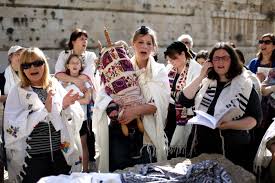
The description of the scene fairly leapt off the page: Shabbos at the Kosel, people davening, a paraplegic in a motorized wheelchair, a group of Orthodox Jews approaching…

“…like a big-league pitcher [one religious Jew] cocked his arm and flung the rock at the man in the wheelchair. The rock hit him in the middle of his forehead, his neck reeled back and blood oozed down this face… Then the adorable little children, who only seconds ago were throwing candy [at a bar-mitzvah boy] turned into savages and started picking up rocks and hurling them at the man. Two of them grabbed the brightly colored prayer shawl from around the man’s neck and cracked it like a whip in his face.

“Some Americans tried to intervene but were themselves stoned. Nearby guards stood by, apparently assuming that the man was getting just punishment for his crime: using electricity on the Sabbath.”

That report appeared in the November 15, 1994 issue of the Arizona State University daily paper, The State Press; it had been recommended for publication by the chairman of the university’s journalism department and the director of the school’s Walter Cronkite School of Journalism. It was, after all, compellingly written and important.

Only one problem: what it described never happened.

Eventually (although after being read by thousands), the report was retracted, when a law student dared to demand corroborating facts and none were found. Pressed for the truth, the aspiring 24-year-old senior journalism major who had penned the piece admitted that the entire account, from start to finish, had been the product of nothing but her own fertile imagination.

It was a particularly gross, but far from singular, example of journalistic malpractice in the realm of reportage about Orthodox Jews. In Moment Magazine’s February, 2000 cover story, which carried the title of this column, I detailed a number of more subtle, but perhaps even more disturbing for the fact, journalistic “liberties” taken by media when “reporting” on the Orthodox community. And in the years since, countless others have come down the pike.

Only last week, a video by an Israeli broadcaster, Reshet TV, depicted reporter Guy Hochman walking around Bnei Brak holding an Israeli flag. The video showed two chareidi motorcyclists grabbing the flag and breaking it.

Another news organization, however, Kol Hazman, reported that the video had been orchestrated by Mr. Hochman himself. And an eyewitness recounted that, before the depicted incident, the reporter had walked “for four hours on the streets of Bnei Brak without being attacked.”

Then a man claiming to be one of the motorcyclists claimed he had been asked to break the flag as part of a “satirical skit,” and just wanted to be of assistance to the reporter.

At first, Reshet TV denied that the video had been manipulated. Several days later, however, the respected Israeli business newspaper The Marker reported that, apparently, it had been, and that the broadcaster had dismissed both Hochman and his editor.

Are there chareidim who act indecorously? Of course there are. But what does it say that media seek out misbehavior, and even, when they can’t find any, fabricate it?

Depressing, no? But we must remain hopeful that, even after so many years of anti-chareidi animus, haters might one day come to their senses.

Just before Pesach, a CNN program depicted Israeli chareidim as a threat to the country, as potentially doing to Israel what the mullahs did to Iran. I wrote an article for a secular Jewish publication pointing out the ridiculousness of that contention.

Most of the responses I received were positive. In the opposite category, though, was one from someone I’ll call E. S. (he signed his full name), a self-described Conservative-turned-Reform Jew. He called chareidim “an abominable blight upon world Jewry and an absolute curse within Israel,” and wants “the entire detestable bunch” to be driven out of Israel “with bayonets and bullets.”

There was more, too, but I’ll spare you. The degree and illogic of the loathing, though, seemed familiar; I remembered something, and decided to write him back.

After politely responding to various accusations he made, I wrote: “I’m heartened, though, by my knowledge that no less a luminary than Rabbi Akiva once remarked that, back when he was an ignoramus, he would have viciously bitten any Torah scholar he came across ‘like a wild donkey’.”

“So I retain hope,” I concluded, “that one day you, too, may have your mud-covered glasses wiped clean.”

His, and others’.

© 2017 Hamodia

An Impossible Pretzel

Some people, it seems, like some dogs with teeth planted firmly in mailmen’s legs, just can’t let go.

Take Peter Beinart.

I have no problem with the columnist and former The New Republic editor’s expressing liberal Zionist views, much as I may disagree with some of them. There is room in this world for different perspectives.

Nor am I particularly vexed by his longtime opposition to President Trump; the president has certainly left himself open to criticism on many occasions. Mr. Beinart’s past insinuation that the president harbors tolerance for anti-Semitism was a silly and unfounded charge, but there are always plenty of those to go around.

What’s more troublesome is the columnist’s refusal to give Mr. Trump credit when it is due, like after the president’s speech last week at the United States Holocaust Memorial Museum in Washington.

Speaking to a crowd of several hundred at the museum, and belying once and for all accusations of his insensitivity toward the Jewish people, the president spoke of how “the Nazis massacred six million Jews,” how “two out of every three Jews in Europe were murdered in the genocide.”

Addressing survivors present, he said, “You witnessed evil, and what you saw is beyond… any description,” and asserted that, through their testimony, they “fulfill the righteous duty to… engrave into the world’s memory the Nazi genocide of the Jewish people.”

He also spoke of Israel as “an eternal monument to the undying strength of the Jewish people.” And he deemed Holocaust denial “one of many forms of dangerous anti-Semitism that continues all around the world,” concluding with the words: “So today we mourn. We remember. We pray. And we pledge: Never again.”

Enter Peter Beinart. Well, not into the museum, but into the pages of the Forward, where he cited Mr. Trump’s recounting of the story of Gerda Weissman, who, in 1945, as an emaciated 21-year-old veteran of Nazi work camps and a death march, was liberated, and elated to see a car sporting not a swastika but an American star. Her liberator turned out to be a Jewish American lieutenant, Kurt Klein, and they eventually became husband and wife.

Mr. Beinart reflects on “how [Mr. Trump’s] views might have affected people like Gerda Klein had he been president back then.” The original “America Firsters,” war-era isolationists, he contends, “shared a mentality” with the president – to protect the United States’ “shores and its people” and to “not squander money and might safeguarding foreigners in distant lands.”

“It is this mentality,” he asserts, “that earlier this year led Trump to propose a budget that cuts U.S. funding for the United Nations in half,” which could bring about “the breakdown of the international humanitarian system as we know it.”

The postwar Displaced Persons Camps, Mr. Beinart goes on to remind us, were administered by a U.N. commission, and paid for largely by the U.S. President Trump, he confidently states, “would likely have seen it as a prime example of other countries ripping America off,” and would “surely have disapproved,” in 1946, when anti-Semitic pogroms in Poland “sent tens of thousands of Jews streaming across the border into U.S.-administered DP camps in Germany,” of allowing any of them onto our shores.

Because Mr. Trump is president, Mr. Beinart concludes, “the Gerda Kleins of today are unlikely to see America’s symbols the way she did.”

One needn’t be a proponent of a Mexican wall to recognize that there is no comparison between, on the one hand, caring for people who narrowly escaped a multi-national genocidal effort only to face murderous pogroms, and, on the other, welcoming every foreigner seeking to improve his economic welfare.

Nor need one like Mr. Trump’s immigration ban to understand that, justified or not, the fear of terrorists infiltrating our country is somewhat more plausible today than it was regarding Jews in 1946.

Mr. Beinart, though, insists on twisting Mr. Trump’s sentiments into an impossible pretzel, into something cynical and hypocritical.

“He praises Holocaust survivors today,” the columnist writes about the president, “because it’s politically expedient. But his actions desecrate their memory. Had he more shame, he would not have spoken at the Holocaust Memorial Museum at all.”

But Mr. Trump, Mr. Beinart surely knows, isn’t currently running for office. And if there’s one thing most everyone agrees about, it’s that he expresses things bluntly, as he believes them to be. Had Peter Beinart more shame, he would not have written his article at all.

© 2017 Hamodia

Homicide Prevention

Observant Jews might be lulled into thinking that the issue of physician-assisted suicide doesn’t affect us personally. After all, while there are certainly cases where treatments may rightfully be declined by patients or, if incapacitated, their families, halacha clearly codifies the prohibition against actually acting to end a human life.

The societal issue, however, in fact very much does affect us. And not just because a culture that sees life as a commodity worth preserving only if it meets certain “standards” of liveliness flouts a universal, fundamental charge that the Torah directs at all human beings. But because societal sanction of ending the lives of “terminal” patients (and every living thing, of course, has a terminus, since Adam Harishon) may come to endanger our own lives.

No, not necessarily because of overzealous doctors and “mercy killers,” though both do exist. Dr. Jack Kevorkian may no longer be active; he departed this world himself in 2011, though not before helping 130 people (according to his lawyer) predecease him. Nurse’s aide Donald Harvey, who was recently beaten to death in his Ohio prison cell, claimed to have poisoned or suffocated 87 people.

The less obvious, more insidious threats, though, are… insurance companies.

Physician-assisted suicide is legal in several European countries and, in the U.S., in Washington D.C. and six states, including California.

Last year, an ailing California wife and mother of four, Stephanie Packer, who had been diagnosed with a terminal form of scleroderma, said her insurance company initially indicated it would pay for her to switch to a different chemotherapy drug at the recommendation of her doctors.

But shortly after California adopted its “End of Life Option Act,” which authorizes doctors to diagnose a life-ending dose of medication to patients with a prognosis of six months or less to live, Ms. Packer’s insurance company informed her that her coverage for the new drug had been denied.

She says that she then asked whether suicide pills were covered under her plan, and was told that, yes, they were, and that she would have to shoulder only a co-pay of $1.20 for the medication. A bargain.

There may have been no causal connection between the then-new California law and the denial of coverage for Mrs. Packer’s prescription. But it can’t be denied that, as physician-assisted suicide becomes available in more states, which will likely happen, it will be regarded by the public and by insurance companies as an enticing option to providing expensive life-prolonging medicines.

The New York State legislature is currently considering a bill that would permit physician-assisted suicide. What’s more, the New York State Court of Appeals, the highest state court, is considering a case that, if decided in favor of the plaintiffs, will legalize assisted suicide in New York without any legislative overturning of the current ban on the practice.

As reported before Pesach in Hamodia, the case, Myers v. Schneiderman, is an effort to claim a constitutional right to enlist help in committing suicide. The plaintiffs argue further that existing end-of-life laws were never intended to restrict terminally ill, mentally competent patients from deciding that they no longer wanted to live. Lower courts rejected the plaintiffs’ claim, which has now led them to the Court of Appeals.

Agudath Israel of America has filed a “friend of the court” brief in the case, pointing to the experience of its Chayim Aruchim division, which has handled hundreds of cases where critically ill patients and their families have been subjected to substantial pressure to allow physicians to withhold lifesaving treatment in end-of-life situations.

In many of those cases, health-care facilities have simply refused to provide the treatment the patient or his health-care proxy requested, claiming that the patient’s “quality of life” was so diminished that there was no point in pursuing treatment.

Agudath Israel’s brief asserts that health-care facilities have withdrawn nutrition, hydration, medication, and other forms of life support from patients even over “the adamant objections of the health-care decision-makers for the patient, and against the explicit wishes of the patient as stated in the patient’s advanced health-care directive.”

Whatever the fate of New York’s ban on assisted suicide, though, it can’t be denied that the idea that a person has a right to enlist others to help end his life is on the ascendant in contemporary society. It is, after all, consonant with the decidedly un-Jewish but nevertheless lauded concept of personal autonomy embraced by so many.

But it needs to be fought at every step, to protect the rest of us.

© 2017 Hamodia

Fear Itself

A navi I’m not, but, still, it was good timing. Several weeks back, at the height of the fears fomented by bomb threats against U.S. Jewish institutions, I wrote an article for an Israeli newspaper gingerly pointing out that, of the nearly 150 threats and building evacuations and searches, not a single bomb had been found.

All that is needed, I noted, to make an effective anonymous crank call, is an unlocked cellphone and a prepaid SIM card – and “using the internet to make an untraceable call is even easier.”

I pictured a shlub without much of a life making such calls, to wield “power” or get attention, “Maybe he is even capable of true violence,” I wrote, “but then again, maybe not.”

It turned out, of course, that many, if not most, of the threats were indeed baseless, although it wasn’t a shlub who made the calls (hey, I said I’m not a navi) but, apparently, an emotionally compromised individual in Israel.

Jew-hatred surely exists, even in the U.S. There are, as there have long been, bands of neo-Nazis, radical leftist “defenders of Palestine” and other assorted misfits with overheated imaginations preparing to wage war against an imagined Jewish menace.

I’m personally acquainted with anti-Semitism, too. When I was a youngster in Baltimore, during recess one day, a group of non-Jewish neighborhood boys asked my classmates and me if they could join our baseball game. Nice kids that we were, we said sure. Once at bat, though, the opposing team suddenly lost interest in the game and turned our own Louisville Slugger bats against us. It wasn’t a pretty sight.

And a few years later, as a teen, when my father and I would walk to shul, we’d regularly hear “Heil Hitler” shouted at us by kids. In fact, mere months ago, the same phrase was aimed at me by one of a group of boys on a city bus. (I regret not having calmly asked him his name and tried to turn the encounter into a “teaching moment.” Alas, I was so disgusted, all I could summon to say to him was a frustrated “What in the world is wrong with you?”)

But it must be admitted – and appreciated – that, unlike in some European countries, there is very little actual violence against Jews in America today. In 2015, the ADL cited fully seven cases of stones or eggs having been thrown, or bb-pellets shot, at Jews – nationwide, over the course of the year. The sort of serious anti-Jewish knifings, shootings and arsons that have occurred elsewhere are simply not part of the American scene.

And as far as mainstream America is concerned, a recent survey by the Pew Research Center revealed that Jews are the most warmly regarded religious group in the country. My personal experience, despite outliers like the boy on the bus, corroborates that.

More emblematic of America than name-callers or stone-throwers were the non-Jewish riders of the subway in New York City in February who, encountering anti-Semitic graffiti on a subway map, banded together to erase it. Or the Montana town that, faced with a planned anti-Jewish march nearby, issued a resolution “denouncing hate, bigotry, and intolerance, which today masquerade under euphemisms such as ‘white nationalism’ and the ‘alt-right.’”

We Jews, for good reason, live our lives against a subtle backdrop of fear, even in countries as wonderful as the one we American Jews are fortunate to call home at present. But keeping perspective is always proper. One of the k’lalos, after all, in the Tochachah in parshas Bechukosai (Vayikra 26:36) is that we will flee at “the sound of a rustling leaf,” that we’ll perceive enemies where there aren’t any. And that is a bane, not an ideal.

There are times for anxiety, to be sure. But there are also times, too, to feel deeply thankful for our security. The words many attribute to R’ Nachman miBreslov, that, on the narrow bridge that is the world, the main thing is “not to be afraid at all,” are not, in fact, his words. What he wrote (Likutei Tinyana, 48) was not “lo l’fached”—“[one should] not fear,” but, rather, “shelo yispached” – “[that one] not become fearful,” not, in other words, frighten himself.

I’m no Pollyanna when it comes to potential danger for Jews. I’m not in the “It can’t happen here” camp. Of course “it” can. Jewish fortunes have turned on dimes throughout history.

It just isn’t happening now, and it behooves us to reflect on that great brachah.

© Hamodia 2017

Black Hats Don’t Always Mean Bad Guys

In an enlightening example of how the rush to publish “juicy” stories without doing the requisite research can lead media to propagate falsehoods, a New Jersey radio station, NJ 1015, broke a story recently that was, well, itself broke – bereft, that is, of fact.

The news station, the flagship broadcasting arm of the Townsquare New Jersey News Network, apparently taking its “information” from a blog, described what one of its personalities, Jeff Deminski, called a “truly disgusting situation,” one that, he asserted, “most will be afraid to talk about because they want to be politically correct” – i.e. uncritical of Orthodox Jews.

Lakewood, New Jersey, as is well known, is home to a large and growing Orthodox population.  A large mall is being considered by the local township’s planning board.  Some Orthodox residents are in favor of the project, others opposed (so much for the image of a solid Orthodox bloc).

The blog and the radio station asserted that 1,200 Orthodox Jews had signed a petition opposing the mall, on the grounds, among other things, that it might include stores owned “by goyim.”

Another commentator on the station, Sergio Bichao, quoted the petition further as fretting that “the presence and influence of non-Jews,” should the mall be built, “is terrifying.”  Mr. Bichao took the opportunity to reprise other alleged local Orthodox nefariousness, like the community’s utilization of the school board to spend “tens of millions of public dollars on tuition and transportation for students to attend out-of-district special-education and religious schools,” to the detriment of “black and Latino” public school students; and accusations against “Lakewood developers and religious leaders of promoting ‘blockbusting,’ the practice of scaring off homeowners with the specter of an invading ethnic minority — in this case, Orthodox Jews — in the hopes of driving down real estate prices in order to spur a buyer’s market.”

Never mind that the law requires school districts to provide special education in appropriate settings to all its school children (even Orthodox Jewish ones), and that insufficient funding is available to the Lakewood district to maintain its current educational needs; or that the actions of one of two individuals acting on their own who aggressively offered to buy Lakewood-area homes were attributed to the entire Orthodox community – or that their methods were widely condemned by other Orthodox residents and leaders.

All that matters is that the bad guys be the ones with the black hats.

But what also matters, or should, is truth.  It turns out that the blog had it wrong (and has since removed the post and issued a correction).

The “petition” that contained the offensive language was an open letter created by one misguided fellow. The actual petition that had garnered 1,200 signatures consisted of two lines of text, reading, in a medley of Hebrew and English: “We are requesting from Cedarbridge Corporation [the developer promoting the mall project] to withdraw from their involvement in making a shopping center in our town.”

The signatories to that petition have reasons to oppose the mall project.  Aside from traffic issues and such, there is the fact that among the values held dear by the Orthodox community is a rejection of materialism – the sort of excess on which shopping malls are arguably predicated.

Smaller commercial projects, aimed at providing material necessities rather than enticing people to buy stuff they don’t really need abound in the community.  And their proprietors include both Jews and non-Jews.

What’s more, the sort of businesses that inhabit malls nationwide include some, owned by Jews or by non-Jews, whose advertising and storefront displays are far from consonant with the Orthodox stress on modesty.

But whatever side of the “mall in Lakewood” issue anyone may be on, there is – or should be – only one side worthy of backing on the issue of news organizations’ responsibility to do due research on stories they provide the public – particularly when an inaccurate story is likely to engender animus toward an identifiable racial, ethnic or religious group.

Why I’m Not Bullish on Fearless Girl

For two decades, I’ve passed “Charging Bull,” the iconic bronze statue that stands near Wall Street, twice every workday when I walk from the Staten Island Ferry to my office in Manhattan. Now, I have to pass her too.

I was never particularly fond of the beast, which always struck me as a bronze descendant of the Golden Calf. Now ‘Fearless Girl,” a new statue of a young lady in high tops who leans in defiantly just a few feet from the bull’s horns, leaves me equally unimpressed.

Read more here.

Callousness or Conscientiousness?

The most incriminatory and unarguable allegation leveled by some Senate Judiciary Committee panelists against Supreme Court nominee Judge Neil Gorsuch was, apparently, that he isn’t Merrick Garland. Guilty as charged.

Mr. Garland, of course, for anyone blessedly short of political memory, was former President Barack Obama’s nominee for the seat left vacant since the death of Justice Antonin Scalia in February, 2016. Republican senators refused to schedule a hearing for that nominee since, they argued, a new president would be inaugurated a mere ten months later.

In this observer’s mind, and entirely unrelated to either my feelings about Mr. Obama or the fact that Judge Garland is Jewish, that refusal was a failure of congressional conscience. No matter how lame a presidential duck may be (and ten months is a substantial amount of time for a waterfowl to limp about), a sitting president has a right to nominate a candidate for a vacant Supreme Court seat; and the legislative branch, a responsibility to fairly consider him.

But the fact that something unconscionable was done cannot change reality. Bad things happen (or are wrought), but life must go on. Mr. Garland’s mistreatment does not implicate Mr. Gorsuch in any way. And the latter, as per his reputation and his thoughtful responses during the Senate Judiciary Committee hearings, is an individual eminently qualified to serve on the nation’s highest court.

Less incriminatory, and entirely arguable, were two other charges brought against the nominee: that he once made remarks disparaging to expectant mothers, and that he showed callous misjudgment in a fraught legal case, ruling for an employer against an employee.

In the first case, a former law student of Judge Gorsuch alleged that, in a course at the University of Colorado Law School last year, he told his class that employers, specifically law firms, should ask women seeking jobs about their plans for establishing a family, and implied that women routinely manipulate companies when they are interviewed, in order to extract maternity benefits.

Asked if the charge was true, Mr. Gorsuch replied, “No.”

“I would have never have said [such a thing],” he continued, “I’d be delighted to actually clear this up.”

In a letter to the committee, another student in the class disputed the account. And a former law clerk for Mr. Gorsuch, Janie Nitze, said that when she heard the allegations, “I didn’t know whether to laugh or cry.” She and 10 other female former clerks also sent a letter to the committee in support of the candidate. In it, the 11 women asserted that “The judge has spoken of the struggles of working attorneys to juggle family with work obligations; not once have we heard him intimate that those struggles are, or should be, shouldered by one gender alone.”

The second attempt to portray Mr. Gorsuch as an ogre involved the case of a truck driver who was fired for abandoning his cargo trailer when its brakes froze in sub-zero temperatures. The unfortunate man, after repeatedly being told by the company to stay put since help was on the way, decided – entirely understandably, considering the temperature and the malfunctioning of the heater in the truck cab – to detach the trailer from the cab and drive away.

The legal question in the case was whether a “whistleblower” provision that protects a driver when he “refuses to operate a vehicle” because of safety concerns covered the trucker who chose instead to operate his vehicle.

It may have been heartless for the employer to fire the trucker, in other words, but did it violate the letter of the statute? Judge Gorsuch, in a dissent to a 2016 ruling by his two colleagues on a three-judge panel of the U.S. Court of Appeals for the Tenth Circuit, contended that it did not.

For that stance, the nominee was painted as heartless himself, unconcerned with the “little guy.” But an American judge, of course, no less than, l’havdil, a posek in a monetary issue, must render his dispassionate judgment, devoid of sympathy or antipathy toward either litigant, “big company” or “little guy.” The Torah enjoins us to not “favor the face of the poor one” in court (Vayikra, 19:15).

In 97 percent of 2,700 cases, Mr. Gorsuch noted, his judgments were part of unanimous decisions; and he was in the majority 99 percent of the time.

No, he’s not Merrick Garland, it must be conceded. He is Neil Gorsuch.

And eminently qualified for a seat on the republic’s highest court.

© 2017 Hamodia

Unfair Play

In the current polarized political atmosphere, where “team” mentality – “our guys are great, yours are bums” – seems to be the default state of mind, and where objective, thoughtful fairness is the rarest of birds, it must be particularly hard to be a black conservative Republican.

Like Justice Clarence Thomas, Stanley Crouch and Thomas Sowell before him, Dr. Ben Carson, the once-presidential candidate and now Housing and Urban Development Secretary, was recently reminded of the perils of that identity, when an entirely innocent comment he made was blown out of all proportion by a horde of players from Team Black and Team Democrat.

As he began his first full week leading HUD, which provides housing assistance to low-income people and development block grants to communities, and enforces fair housing, Dr. Carson spoke to a standing-room-only audience of the agency’s employees.

He praised them for their dedication to HUD’s mission of “helping the downtrodden, helping the people in our society to… climb the ladder.” And then he extolled the United States as a land of opportunity, saying: “That’s what America is about. A land of dreams and opportunity. There were other immigrants who came here in the bottom of slave ships, worked even longer, even harder for less. But they, too, had a dream that one day their sons, daughters, grandsons, granddaughters, great-grandsons, great-granddaughters might pursue prosperity and happiness in this land.”

The positively lupine reaction to that eloquent paean to America was to pounce on Dr. Carson’s pointedly loose use of the word “immigrant” with reference to African slaves brought to these shores in the 18th and 19th centuries. From the overheated comments that suffused the media, one would have thought that the doctor had extolled slavery rather than the aspirations of slaves, that he had made a direct comparison rather than a clear contrast.

Pundits and academics across the land rent their garments at the desecration, and Congressman Keith Ellison of Minnesota railed that Dr. Carson had shown a “stunning misunderstanding of history… a very scary thing,” and declared that the doctor’s perspective makes him unqualified to lead HUD.

I don’t know what sort of president Dr. Carson would have made, had he prevailed in the Republican primary. He certainly showed misjudgment by imagining that civility is something appreciated by the American electorate.

But I find it easy to envision that he might be just what an agency like HUD needs: someone who recognizes that, however dismal one’s past was or one’s present is, the healthy attitude is fortitude, seeing opportunity in the future and recognizing the role one can play in his own destiny.

Dr. Carson’s personal story exemplifies that well. A poor student in Detroit with, by his own recounting, an anger management problem, he “ask[ed] G-d to help me find a way to deal with this temper” and studied Mishlei. The passuk, he says, that spoke to him most powerfully was “Tov erech apayim migibor…” – “Better a patient man than a mighty one, [better] a man who controls his temper than one who overtakes a city” (16:32). He set himself to the task of self-improvement and earned a full scholarship to Yale, working summers as, variously, a clerk in a payroll office, a supervisor of a crew picking up trash along the highway and on an assembly line. At Yale, he worked part-time as a campus student police aide.

In 1984, when he was 33, Dr. Carson became the director of pediatric neurosurgery at Johns Hopkins University, the youngest doctor in America at the time to hold such a position. And he went on to distinguish himself, pioneering groundbreaking surgeries and receiving the Presidential Medal of Freedom, the highest civilian honor in the U.S., in 2008.

Interestingly, an American president, during a naturalization ceremony at the National Archives, made a similar point to the one that earned Dr. Carson such opprobrium.

He said that “Life in America was not always easy. It wasn’t always easy for new immigrants. Certainly it wasn’t easy for those of African heritage who had not come here voluntarily, and yet in their own way were immigrants themselves… But… they no doubt found inspiration in all those who had come before them. And they were able to muster faith that, here in America, they might build a better life and give their children something more.”

That was Barack Obama, in 2015.

Dr. Carson, in his speech, pledged to lead the agency with an “emphasis on fairness for everybody… complete fairness for everybody.”

How shameful that fairness seems to utterly elude the “team players.”

© 2017 Hamodia

Deportation Vexation

My wife and I don’t employ an undocumented housekeeper – or a documented one, for that matter. But we recently met someone in the former category. “Leah” greeted my wife and me as we arrived at the home of some friends who had invited us for a Shabbos seudah. Our hosts had not yet returned from the shul where they daven, and so I retired to the living room, and my wife went to the kitchen and spoke a bit with Leah, who had immigrated from south of the border.

It turns out that Leah loves working for our friends, and considers them among the nicest people she’s ever met. We weren’t surprised. We have good taste in friends.

It turns out, too, that she lives in fear of deportation, now that the administration is engaged in a crackdown on “illegal immigrants.” On February 6, Immigration and Customs Enforcement (ICE) agents began carrying out “fugitive enforcement operations.”

According to the Department of Homeland Security, more than 680 people were arrested in five cities that week.

It wouldn’t seem, though, at least at first glance, that Leah really has much to fear. The crackdown is aimed at criminal elements, and she, other than having immigrated unlawfully, is a law-abiding person. In the words of President Trump’s recent tweet, “Gang members, drug dealers & others are being removed!” Not housekeepers. Or gardeners, like the ones the president referred to in 2013 when, according to someone present, he told a group of young people born to undocumented workers: “You know, the truth is I have a lot of illegals working for me in Miami… my golf course is tended by all these Hispanics – if it wasn’t for them my lawn wouldn’t be the lawn it is; it’s the best lawn.”

In fact, going after undocumented criminals was precisely the policy of the previous administration, which deported no less than 409,849 people in 2012. In 2015, The ICE, in “Operation Cross Check,” arrested more than 2,000 undocumented immigrants with criminal records in one week. And even when the Obama administration shifted its enforcement priorities so that the vast majority of the estimated 12 million undocumented immigrants would not be subject to immediate deportation, it still went after convicted criminals, terrorism threats and recent immigrants with gusto.

So what, if anything, has changed?

Well, the language, for starters. Mr. Trump called the crackdown “a military operation,” though that description was walked back by White House press secretary Sean Spicer, who explained that the president had been speaking descriptively, not literally.

But there is, in fact, a larger pool now of potential deportees, more people deemed enforcement “priorities.” An undocumented immigrant needn’t have been convicted of a crime to be deported. He or she can simply be charged with a crime, or deemed to have committed an act that an immigration agent considers, on his own, a deportable offense. What’s more, for the first time, ICE policy now allows the arrest of undocumented immigrants who have only immigration violations on their record, if they happen to be discovered in the course of law enforcement actions.

That, it seems, is what Leah was frightened of. While stories of ICE personnel conducting random “raids” in various public places, and their supposed plans to arrest people on their way to worship have been decisively debunked, she had heard of undocumented people with traffic misdemeanors being arrested.

Leah might take heart in the president’s apparent shift on DACA, former President Obama’s Deferred Action for Childhood Arrivals program, which allows “dreamers,” people who illegally immigrated as children, to remain in the U.S. and work.

On the campaign trail, Mr. Trump vowed to “immediately terminate” the program. But – deeply angering some of his more anti-immigrant supporters – he has since softened his tone, calling most of the roughly 840,000 immigrants “incredible kids” and the topic of their status “one of the most difficult subjects I have.”

And while he weighs the issue of “dreamers,” and lawmakers of both parties in Congress are trying to devise legislation to carve out a special status for them, the administration is still issuing work permits to undocumented people under the DACA program.

That is an encouraging sign, at least to those of us who feel concern for young people brought over to the U.S. as children, and for all immigrants like Leah, who are only seeking better lives for themselves and their families. We Jews, both inherently and in light of our own recent history, should have a special appreciation of their hopes to one day become full-fledged American citizens.

© 2017 Hamodia