Category Archives: PARSHA

Ki Sisa — Knot Theory

The Hebrew words panim and achor (as in lifnei and acharei) are used in both a spatial and temporal sense – either as “front” and “back” or as “before” and “after.”

One approach to the  mysterious revelation of Hashem’s glory to Moshe as he gazed from a cleft in a rock (Shemos 33: 18-23) sees forms of those words as referring not, as they most simply read, to the dimension of space but, rather, that of time.

“You will see My ‘back’ but My ‘face’ [or ‘front’] will not be seen” is what Hashem tells Moshe. The Chasam Sofer and Rav Tzadok HaCohein both understand that along the lines of “You may understand My ways when they are behind you in history, but the future (and even present) will not be perceptible.”

I wonder if what permeates and drives both the past and the future might lie in what Chazal comment on the word for “My back”: “He showed Moshe the kesher shel tefillin, the ‘knot at the back of the phylactery [placed on the head]’” (Berachos 7a). 

And indeed, the Gemara (ibid, 6a) says that Hashem, in some sense, “wears tefillin.” 

What occurs is that the word kesher can mean not only knot but also “bond.” The Gemara tells us that, while our own tefillin contain pesukim praising Hashem, the divine tefillin contain a pasuk praising His people (ibid).

Might “kesher shel tefillin,” here, be a pun of sorts, referring to the eternal bond binding Hashem to Klal Yisrael? And may that bond be the essential thread that runs through human history – past, present and future?

© 2024 Rabbi Avi Shafran

Tetzavah – Divine Right vs. Divine Role

There’s really no such thing as a kohein.

At least not the way we generally pronounce the word in conversation, with the accent placed on the first syllable. In the Torah, the stress is on the second syllable, a hint to the fact that the word is not a noun but rather a verb. 

That is Rashi’s observation in the parsha (29:30), on the words hakohein tachtav, which can only be properly translated as ‘who ‘koheins’in his stead” – with kohein meaning “serves.” (The cantillation, Rashi notes, would not support translating the phrase as “who is a kohein in his stead.”)

That may be nothing more than an interesting grammatical observation. But it may also signal something deeper.

Kohanim, of course, derive their status from being descendants of Aharon. In the non-Jewish sphere, special roles can also be transferred genealogically, as in monarchies.

But the “divine right of kings,” whereby monarchs claimed authority that rendered them unaccountable for their actions by earthly laws and courts (a topic that remains germane, oddly, even today, even in democracies) could not be further from the divine role of kohanim. A kohein is as governed by the Torah’s laws as any other Jew.

Kohanim are verily defined as “servers,” as being charged to do Hashem’s will. They are not defined by a noun but a verb – referring to performing the acts they are commanded to perform.

To be sure, kohanim have a special status in Klal Yisrael and are deserving of honor. But their specialness is born of mission, not license or immunity.

Truth be told, every one of us is, each in his or her way, special, whether we happen to carry a particular title or are just the unique individuals each of us is. And we all are likewise defined not by our particular statuses or identities, but by our missions. 

© 2024 Rabbi Avi Shafran

Terumah — Ulterior Merits

The aron habris, the ark of the covenant that held the luchos, the tablets of the law, consisted of three nested boxes, the middle one of wood, the outer and inner ones of zahav tahor – “pure gold.” Its kapores, or cover, was made entirely of “pure gold.”

Not so the poles that are placed in rings on the sides of the aron – and that are to remain there permanently. Like the aron itself, they are wooden but covered with gold. But only “gold,” not “pure gold” like the aron’s inner and outer boxes.

In his sefer Nachalas Tzvi, Rav Meshullam Gross notes that difference and sees in it the fact that those whose lives are dedicated to Torah-study, symbolized by the aron, must be pure-hearted and not motivated by ulterior motives. Those who support them, however, who are symbolized by the poles with which the aron was carried, may condition their support on other things.

Ulterior motives do not cancel the merit of Torah-support or other meritorious giving. As the Talmud (Pesachim 8a) teaches: “One who says: I am contributing this coin to charity so that my son will live… is a completely righteous person.”

A common ulterior motive in philanthropy is honor. That is why donors’ names on plaques in shuls, Jewish outreach centers and yeshivos, or on the edifices themselves are perfectly proper.

In fact, such displays can constitute great merits in their own rights.

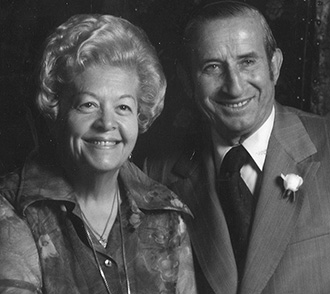
One of the most generous donors to Torah causes was Joe Tanenbaum, whose name, along with his wife Faye’s, graces wonderful institutions not only in his adopted city Toronto but across the globe. As a child, he hadn’t received a thorough Jewish education and he wanted others to have every opportunity to Jewishly educate themselves.

He was, though, by all accounts, a most modest man. A story that made the rounds many years ago is that he was once asked why he wanted his and his wife’s names to be prominent on the facades of the countless Torah-promoting buildings.

His reply was that, in the event that one of his future descendents should for some reason not receive a Jewish education or fall away from the Jewish path, he hopefully imagined the young person seeing the name Tanenbaum on an edifice and, carrying the same surname or knowing it was in his or her genealogy, becoming sufficiently intrigued to enter its doors.

© 2024 Rabbi Avi Shafran

Mishpatim – Full Moon Danger

On June 6, 1944, D-Day, more than 150,000 Allied troops stormed the coast of Normandy to begin the liberation of France from the Nazis. 

The criteria for choosing that day included a low but rising tide for the seaborne soldiers, a tide that occurred only around the time of a new or full moon. It took place on the latter.

Other military onslaughts throughout history were scheduled based on the moon’s phase – full moons when light was desired; new moons when darkness was needed to limit soldiers’ visibility to the enemy.

Among the 53 mitzvos in parshas Mishpatim is one that, peripherally, involves the moon. And it is one of the most compelling pieces of evidence of the Torah’s divine origin. Because the mitzvah, by all logic, would seem to doom the Jewish people.

On the shalosh regalim, the three “pilgrimage festivals,” all adult Jewish males are commanded to journey to the Beis Hamikdash in Yerushalayim. That, of course, would leave the borders of Eretz Yisrael essentially open to attack by the Jews’ enemies. And two of those festivals were utterly predictable – because they began on the 15th of their Jewish months, one in the spring (Pesach) and one in autumn (Sukkos). Each at the full moon of its month.

Even the most primitive military strategist would have noticed that pattern and would conclude that the land would be most vulnerable to attack on those holidays. Or, in the summer, during the first quarter moon, when the right half of the moon is lit – the holiday of Shavuos. 

Which makes the mitzvah of alyah liregel starkly self-defeating. No human lawmaker would be cruel or dim enough to lay down such a law – only a Legislator who could in fact ensure that the populace would not perish as its result. And, of course, it didn’t.

© 2024 Rabbi Avi Shafran

Yisro – Experience Required

When I was a teenager, I wrote a short poem that went:

All could be lies

For we see with our eyes.

Descartes, as I later discovered, beat me by some three centuries at expressing the thought that our senses necessarily mediate reality for us and thus cannot be relied upon to yield absolute truth.

That idea underlies the Rambam’s approach to miracles, that they cannot, on their own, conclusively prove anything at all. In his words: “…because it is possible to perform a wonder through trickery or sorcery” (Mishneh Torah, Hilchos Yesodei HaTorah, 8:1).

Even the plagues in Mitzrayim and the splitting of the sea could not prove anything decisively. (And so, once, when a Christian missionary came to my door to tell me of wonders performed by the object of his veneration, I just smiled and said “That’s very nice” and wished him a good day.)

What then, asks the Rambam, was it that fully convinced Klal Yisrael of Hashem’s existence and role in their exodus from Mitzrayim? His answer: Mattan Torah. (ibid).

As he explains (I paraphrase here), the happening at Har Sinai wasn’t something witnessed but, rather, something experienced. Our ancestors didn’t hear or see Hashem; they met Him intimately. They were imbued with His presence.

Which, I suspect, is the upshot of the words “They saw the thunder and lightning” (Shemos 20:15). The people, Chazal comment on those words, saw what normally can only be heard. Because they weren’t seeing or hearing at all as we normally define those words but rather experiencing the reality of Hashem. The synesthesia indicates that Hashem bypassed their senses entirely and entered their very souls.

Which is why the experience was so traumatic: The very pasuk after the one about seeing sound has the people begging Moshe, “You speak with us… let Hashem not speak with us lest we die.”    To use a mundane simile, they had been like overloaded electrical circuits.

But that overload was necessary, if only for the first two dibros. Because it is what established for all generations to come – through the transmission of that experience – the relationship between the Creator and the people he chose to fulfill His mandate and carry His message.

© 2024 Rabbi Avi Shafran

Bishalach – La Différence

Our ancestors’ wondering “Is Hashem in our midst or not?” is followed immediately in the Torah by Amalek’s attack (Shemos 17: 7-8). The word expressing Klal Yisrael’s existential doubt – “or not?” – is ayin, which can also be translated “isn’t,” “not there,” or “nothing.”

It’s a word that we find in a seemingly different context in Koheles (3:19), where Shlomo Hamelech says that u’mosar ha’adam min habeheima ayin – “and the superiority of man over animal is nothing.”  

Which, as it happens, well encapsulates Amalek’s philosophy. Famously, its name in gematria equals safek, doubt, which reflects Amalek’s conviction that human life is meaningless, just the yield of random evolution, that there is in fact no essential difference between people and animals; and, thus, that there is no ultimate meaning to human life.

That sentiment, of course, isn’t Shlomo’s true conviction; he concludes Koheles with the statement that “kol ha’adam” – the essence of man” – is reverence for Hashem and fulfillment of His directives. The “no difference” pasuk is an unwarranted cry of exasperation, not a description of final fact.

I remember seeing a worthy thought about what that word ayin in the Koheles pasuk might hint at, rendering it not an uninformed cry but, rather, a statement of deep truth.

The first time the word ayin is used in the Torah is in the sentence: vi’adam ayin la’avod es ha’adama – “and man was not yet there to work the land” (Beraishis 2:5). 

As Rashi explains, for the first vegetation to emerge, there needed to be rain, and rain would only arrive when there was a consciousness that could appreciate it as a divine gift. The “working” of the land, the avodah alluded to, was thus avodas haleiv, the “work of the heart” – a recognition and declaration of gratitude.

And so, the “difference between man and animal” may in fact be precisely “ayin” – namely, what the word hints at in Beraishis: awareness of Hashem and gratitude for His benevolence, which only conscious human beings can feel and express. 

© 2024 Rabbi Avi Shafran

Parshas Bo – Birth Blood

That Yaakov’s descendants are commanded by Hashem to place the blood of the korban Pesach on the doorposts and lintels of their homes’ doors (Shemos 12:7) is certainly intriguing.

Considering that the Gemara on the first amud of massechta Yoma teaches that “baiso zu ishto,” that the word “his home” in the Torah implies “his wife,” blood on the doors of homes would seem to embody the metaphor of niddah. What pertinence could that possibly have here?

That premise, though, is wrong. The Gemara refers to two types of blood, daam niddah and daam leidah. It’s not niddah being metaphorized here, but, rather, leidah, birth. 

Because something was indeed born out of the blood-adorned doors in Mitzrayim: a nation. A new collective entity called Klal Yisrael. 

In Mitzrayim, the Jews were all related to one another but they could reject that connection. Indeed, many did, and did not merit to leave Mitzrayim, dying there instead.

On their last night in Mitzrayim, though, the rest of the Jews underwent a change. With blood on their doorways and matzoh in their packs, they followed Moshe into the daunting desert, knowing not what awaited them. And became an entity whose members, and descendants throughout history, are part of an organic whole, no matter what any of them may choose to do.

Which is why, in the words of the Gemara, “A Jew who sins is still a Jew,” in every way.  There is no longer any option of “opting out” of Klal Yisrael.

And so, blood in Judaism is a symbol not of death, but of birth.

The words of the navi Yechezkel (16:6) poignantly reflect that fact:

Referring to “the day you were born,” Hashem, through the navi,  tells His people: “And I passed by you as you wallowed in your blood, and I said to you, ‘in your blood, live.’  And I said to you, ‘in your blood, live’.”

© 2024 Rabbi Avi Shafran

Vo’eira – When to Remind Can Be Unkind

It’s intriguing that when Moshe and Aharon are sent to present themselves to Par’oh and to demonstrate the miracle of a staff turning into a snake, Moshe is commanded by Hashem to tell Aharon to throw his staff to the ground to effect the transformation.

Elsewhere, of course, with two exceptions (hitting the Nile and the ground, because Moshe had been saved by water and earth) it is Moshe’s staff that is used to fulfill divine commandments, as in the splitting of the sea and, in the desert, the hitting of the rock to bring forth water. But here, why isn’t Moshe the one charged to cause the miracle?

A lesson may lie in the oddity. Moshe, we remember, was earlier, at the burning bush, told to throw his staff to the ground, where it turned into a snake (Shemos 4:2,3). There, the command was issued after Moshe expressed doubts about whether the Jews would listen to him.

And, as Rashi explains there, the transformation of the staff was not meant as some demonstration of miraculousness but rather as a rebuke to Moshe, for having doubted the Jewish people’s willingness to hear His message.

So perhaps the reason Hashem wanted Aharon and not Moshe to perform the demonstration before Par’oh was to spare Moshe embarrassment over the memory of the rebuke he had earlier received. The reminder, of course, was still there, in a staff turning into a snake. But at least Moshe himself was not asked to perform the very action that had telegraphed the rebuke.

The Mishna (Bava Metzia 58b) says that one may not remind a repentant sinner of his prior deeds, nor a convert’s son of those of his ancestors. Perhaps the lesson here of Aharon being given the order to throw the staff down is that even a subtle reminder can be a source of embarrassment to another, and thus, something to carefully avoid.

© 2024 Rabbi Avi Shafran

Shemos – Working the Empathy Muscle

Each of us lives at the center of a series of concentric circles, the closest one encompassing our immediate family members; the next, friends and neighbors; beyond that, co-religionists or fellow citizens of one’s country. At a distance removed even farther is the larger circle of human beings with whom we share similar values. And further out still, the circle encompassing the rest of humanity.

I once wrote an essay contending that it is no sin – in fact, it is proper – that we feel, and demonstrate, our deepest love for the circle closest to us. And greater concern for the next circle out than for those beyond it.

Some Jews seem embarrassed at the idea of Jews acting with special alacrity on behalf of fellow Jews. But they are misguided. 

In fact, I suggested, the only way to feel any concern for the “outer circles” is to hone one’s love for those in one’s inner one first. Exercising the “empathy” muscle with regard to those closest to us is what allows us to have true empathy at all for those most distant.

Moshe Rabbeinu, the “most humble of all men,” was not naturally given to interfering in conflicts. And yet we find him doing so thrice in the parsha: First, by killing the Mitzri who was beating a Jew; second, by berating a Jew who was hitting another Jew; third, by standing up to the non-Jewish shepherds who were bullying the non-Jewish daughters of Yisro.

A dear talmidah of mine from long ago, Tanya Farber, suggested that my observation about how empathy for those distant from us is only enabled by first feeling, and acting upon, empathy for those close to us may inform Moshe’s interventions. What empowered Moshe’s decision to stand up for Tzlafchad’s daughters may have been his standing up earlier for fellow Jews.

The only way to truly “love humanity,” and not just mouth half-hearted concern for it, is to first concentrate on the easier, but essential and prime, endeavor of loving those to whom we are closest.

© 2024 Rabbi Avi Shafran

Vayechi – Missing Letter, Vital Message

All the letters of the Hebrew alphabet are found in the bracha that Yehudah is given by his father Yaakov – with one exception: the zayin.

That fact is pointed out by Rabbeinu Bachya, who notes that zayin is not only a letter but a word – meaning “sword” or, more generally, “weapon.”

He writes: 

“The reason is that the malchus Yisrael, which emerges from Yehudah, will not score its essential victory through the use of weapons like [ victories achieved by] other nations. Because the sword is Esav’s heritage but [not] that of the Jewish malchus, which will not inherit the land with their swords. And is not conducted by natural means, with the strength of the hand – but rather, through the… sublime power of Hashem. 

And that is why one finds in the name Yehudah, the source of the Jewish kingdom, the letters of Hashem’s name…”

That fundamental message is always important to internalize, but it is particularly timely today. We have seen, in the Jewish fight against unspeakable evil, failures of military tactics, intelligence and weaponry, and the use of the latter bringing only more hatred against Klal Yisrael. 

May we soon merit to see the success that can ultimately only come from Above.

© 2023 Rabbi Avi Shafran