I’m no fan of Israel’s National Security Minister Itamar Ben-Gvir. But he doesn’t deserve to be accused of saying something he didn’t say.
As I point out here.

I’m no fan of Israel’s National Security Minister Itamar Ben-Gvir. But he doesn’t deserve to be accused of saying something he didn’t say.
As I point out here.
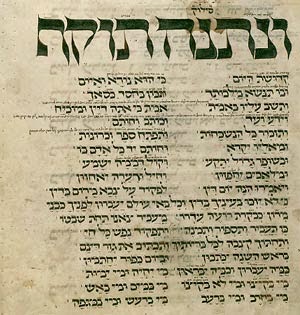
There’s an often overlooked irony in the story of Rabbi Amnon of Mainz, whose poignant tefillah “U’nesaneh Tokef, describing the Ultimate Judge’s opening the book of our deeds and deciding our fates, is solemnly recited on Rosh Hashana and Yom Kippur.
It is a chilling passage to recite – and the haunting melody to which it is traditionally sung only adds to its poignancy. And its final words, “But repentance, prayer and charity remove the evil of the decree,” chanted loudly by the entire tzibbur, are a fount of inspiration and hope for the new year.
The story behind the composition is from the 13th century halachic work Ohr Zarua, written by Rabbi Yitzchok ben Moshe of Vienna.
Rabbi Amnon was pressured by the Archbishop of Mainz to convert to Christianity and refused, finally, as a stalling tactic, asking for three days’ time to consider the offer.
When Rabbi Amnon didn’t visit the clergyman at the end of the three days, he was forcibly taken to him and, adamant in his refusal, was tortured on the Archbishop’s orders. Rabbi Amnon’s fingers and toes were amputated one by one, and he was returned to his home with his twenty amputated limbs.
On Rosh Hashanah, Rabbi Amnon asked to be carried, along with his body parts, into shul, and before Kedushah, intoned U’nsaneh Tokef, dying shortly thereafter. Several days later, one Kalonymus ben Meshulam, according to the account, had a dream in which Rabbi Amnon taught him the words of the prayer.
According to the account, when Rabbi Amnon was brought before the archbishop, the rabbi told the clergyman that he wanted to be punished – not for refusing the conversion offer but rather for having given the impression that he had even considered such a thing. “Cut out my tongue,” he told the archbishop. The clergyman, however, seeing Rabbi Amnon’s refusal to convert as his sin, chose his own punishment for the rabbi, the one meted out.
And so the priest, while he tortured the Jew grievously, left his victim’s tongue in place.
And therein lies the irony. That tongue was what yielded us U’nsaneh Tokef.
© 2023 Rabbi Avi Shafran
I have the great privilege of serving as public affairs director of Agudath Israel of America for nearly 30 years. I joined the staff at the invitation of Rabbi Moshe Sherer, a”h, and am honored to have worked under him, as I am under the Agudah’s current executive vice president, Rabbi Zwiebel.
And then there are my colleagues. It is gratifying to work alongside some of the most dedicated and effective protectors of religious rights, providers of social services, promoters of Torah study and observance, and standard bearers of Judaism.
Above all, it is humbling to work for a Jewish organization that takes its direction from a body like the Moetzes Gedolei HaTorah. Agudath Israel is truly a unique movement.
And it is poised to launch a drive to ensure that it can continue its great work into the future without hindrance .
If you know enough about the Agudah to cherish it (and if you don’t, please spend some time at https://agudah.org/ ), or if you just want to show appreciation for the articles that I produce (whether for the Agudah or for various media, which the organization gives me rein to do), please visit
https://charidy.com/agudahnational/AShafran
and offer whatever you can to help further the cause. Thank you!
AS
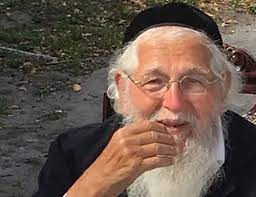
The sorrow I felt at the news that Rav Aharon Schechter, zt”l, had been niftar from this world eventually gave way to the comforting image of his radiant smile and the memory of his personal warmth. And to a particular personal memory of a long-ago, unexpected phone call.
The Yeshivas Rabbeinu Chaim Berlin Rosh Yeshiva’s smile wasn’t born of any calculated forcing of will. It was simply his “default” expression, the physical manifestation of his simchas hachaim and ahavas Yisrael. It receded only when he was deep in thought, saying a shiur, pondering a she’eilah or formulating a response to a question, then giving way to a look of concentration. As soon as the contemplation was complete, the smile quickly, naturally, reasserted itself, coming again to the fore.
Rav Schechter’s brilliance and scholarship were recognized by Rav Yitzchak Hutner, zt”l, who tapped him to take his place in the yeshiva when Rav Hutner moved to Eretz Yisrael to found Yeshivas Pachad Yitzchak in Yerushalayim. And they are evident in “Avodas Aharon,” the sefer Rav Schechter authored back in the 1950s. And his eloquence, whether speaking in Yiddish or English, was striking.
Until illness limited him, Rav Schechter was constantly in the beis medrash, and even learned “bichavrusa” with talmidim. Under his direction and love, the yeshiva became a renowned makom Torah.
But it was his smile, his kindness, his ahavas Yisrael, his concern for everyone with whom he interacted, that first come to my mind when I think of him.
The sensitivity that characterized Rav Schechter was evident in much of what was recounted at his levayah. Although in her later years, his rebbetzin had become progressively unaware of her surroundings, her husband refused to recite kiddush on Shabbos until she was seated at the table, such was his respect for his eishes chayil, diminished in awareness or not. Once, leaving home for the chasunah of one of the rebbetzin’s relatives, he told her he was going to a chasunah. Why, he was asked afterward, didn’t he say whose chasunah he was attending. “I didn’t want her to feel bad that she isn’t able to go,” was his response.
I cannot claim the honor of having been a talmid of Rav Schechter’s. I first met him, briefly, in the early 1980s, when I was a rebbe in a mesivta in Providence, Rhode Island and, by then having become a member of the Moetzes Gedolei HaTorah, he visited the community. (That alone said much about him.)
He observed my shiur and even offered an observation about a perplexing Rashi to me afterward.
I wouldn’t hear his voice again for two or three years, on that phone call.
Those of a certain age might recall a controversy I inadvertently stirred up with an article I wrote in the much-missed Jewish Observer in 1986. On the heels of an earlier JO piece I had written about the radical Reform proponent Abraham Geiger, the magazine’s editor, Rabbi Nissan Wolpin, a”h, asked me if I would undertake one about the Jewish philosopher Moses Mendelssohn.
I said I would happily do so, but, having done some reading about Mendelssohn, knew that, despite the sad fate of his children and disciples, he was no reformer. Rabbi Wolpin insisted that all he was asking for was an accurate portrayal of the man and whatever thoughts I might have to offer about him.
The resultant article, “The Enigma of Moses Mendelssohn,” described him accurately, as having lived an observant Jewish life, even as, professionally, he moved in decidedly unJewish circles.
Although the JO’s respected editorial board, including Rav Joseph Elias, a”h, quite the expert on German Jewish history, had approved my article, it enraged some readers, who had coddled an image of the article’s subject as the “father of Reform.” They felt that my suggestion that Mendelssohn’s inability to keep his students or progeny within the Jewish fold lay in something subtle, a lack of true respect for gedolim of his era, was a whitewashing.
The brouhaha grew so frenzied that the question of how the Jewish Observer should respond was discussed by the members of the Moetzes Gedolei HaTorah. I was told that their ultimate decision – to have the JO express regret for having published the piece – was not favored by all the Moetzes’ members.
Far from the storm, in Providence, any bolts of lightning missed me, and I didn’t really feel its hailstones. But I was told that they were large and many. When I called the Agudah’s offices about something unrelated, the receptionist asked, under her breath, “How are you holding up?”
That’s when I realized that the storm had been upgraded to hurricane status. I was, understandably, not happy. I had, I thought, just reported facts and offered a theory. Some, though, felt I had attempted to rehabilitate a fiend.
When the JO’s apology for running my piece was published, Rabbi Wolpin called me and attempted to take the blame for the hubbub. But he had done nothing wrong. Neither he nor the members of the editorial board (nor I) had any reason to foresee the anger that had ensued.
I was understandably disheartened, though, by the disowning of what I had worked on so long.
It was a Motzoei Shabbos when the phone rang. Caller ID wasn’t yet a thing and so I had no idea who was calling. I picked up and said “Gut voch.”
The voice on the other end said, “This is Schechter.”
“Moishy!” I exclaimed, delighted to hear from my old high school classmate in Baltimore’s Yeshivas Chofetz Chaim, or “T.A.”
“No. Aharon.”
It took me a few seconds to realize whom I was speaking with. But the realization eventually dawned.
“Rosh Yeshiva!” I corrected myself. “I’m so sorry. I thought it was someone else.”
“That’s okay,” he responded. And then he got to the crux of the call. “I just wanted to wish you a gut, gebenched voch. That’s all.”
To say that the call was a balm or chizuk at a difficult time would be an understatement. I don’t recall exactly what I stammered in response to the Rosh Yeshiva’s wish, but I imagine I expressed my hakaras hatov for the call. I certainly felt it.
The kerfuffle over the Mendelssohn piece, like all storms, subsided with time. And, ironically, Rabbi Moshe Sherer, a”h, later offered me a position at the Agudah (which I initially turned down – another story there – but eventually accepted).
I’ve been with the Agudah now for some 30 years. And one of the great perks of working for the organization has been the ability to greet and speak with members of the Moetzes Gedolei HaTorah when they have come to the office to meet.
Approximately two years ago, Rav Schechter attended one such meeting; it would turn out to be his last. He was already physically compromised, but his smile was unfaded, bright as ever. When I went over to greet him, he warmly shook my hand.
And then he asked me if he could hold on to my arm as he made his way down the hall. I was sad that he needed support but couldn’t have been more honored. And that special memory of being able to be of some small assistance to the Rosh Yeshivah has joined the company of another special memory, of an unexpected phone call 35 years earlier.
© 2023 Ami Magazine
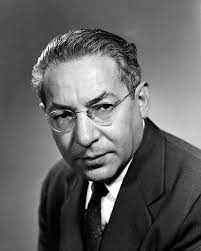
A longform piece I wrote about the Noble Prize laureate physicist I.I. Rabi was published by Tablet, and can be read here.
I always look forward to feedback on columns, whether the responses are positive or critical. The former keep me writing; the latter help me learn.
On occasion, though, a response is just…well…odious.
Like one that I wrote about in last week’s Ami column, which you can read here.

Kol yimei chayecha – “All the days of your life” – is a phrase we first meet in the Torah when Hashem pronounces the fate of Adam after the sin of eating from the eitz hadaas: “Cursed is the ground because of you. Through suffering will you eat from it all the days of your life” (Beraishis 3:17).
The phrase recurs in a seemingly unrelated context, about the mitzvah of eating matzah on Pesach, in our parsha: “…so that you will remember the day you left Egypt all the days of your life” (Devarim 16:3).
That pasuk, cited in the Haggadah, elicited a novel thought from Rav Avrohom, the first Rebbe of Slonim: “When recounting Yetzias Mitzrayim, one should remember, too, ‘all the days’ of his own life – the miracles and wonders that Hashem performed for him throughout…”
The generation before mine, the one that came of age during the Second World War, could well relate to that idea. My father endured years of forced labor in Siberia, courtesy of the Soviet Union. My father-in-law was a veteran of several concentration camps, and suffered the deprivations and tortures for which they are infamous.
And, I know, on Pesach, thoughts of their experiences were in their minds. My father and his friends pocketing and then hiding a few wheat kernels here and there, to be secretly ground and baked in the middle of the night into matzos. My father-in-law, in a Dachau satellite camp, reciting with a friend parts of the Haggadah they knew by heart.
But the Slonimer Rebbe’s thought is appropriate for every life, even lives of relative calm and plenty like our own. Because, as a result of the sin of the eitz hadaas, adversity and tragedy entered the world and came to define all humans’ lives, to one or another extent. We all have experienced things that were daunting or worse, and from which we were saved. We may not have been liberated from a literal gulag or camp, but we are all, on one or another level, survivors.
And we need to consciously recall that fact, all the days of our lives.
© 2023 Rabbi Avi Shafran
Last week, President Biden issued a presidential proclamation recognizing the horrific injustice that was the murder of Emmett Till, a 14-year-old whose brutal killing in Mississippi in 1955 helped galvanize the civil rights movement. A national monument is being created in honor of the murdered boy and his mother, Mamie Till Mobley, who forced the nation to confront the horror of what happened to her son.
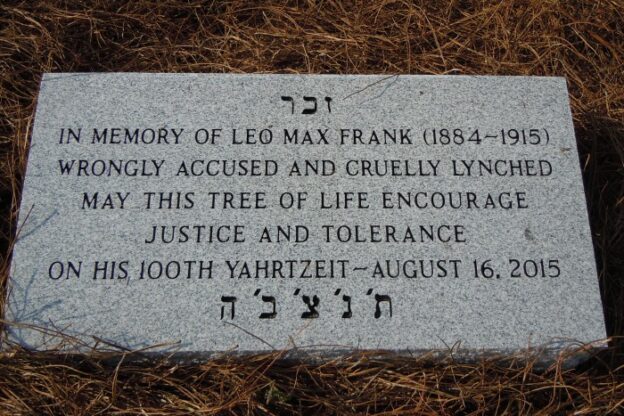
What the revisiting of that evil brought to my mind was another lynching, of a Jewish man in Georgia decades earlier, in 1915. The murder of Leo Frank is a sad part of American history that should not be forgotten.
On April 26, 1913, a 13-year-old girl on her way to Atlanta’s Confederate Memorial Day parade stopped at her place of employment, the National Pencil Company, to collect her paycheck. The next day, she was found murdered in the factory’s basement.
Leo Frank, a 29-year-old Jewish man, was working at the factory that morning and handed the girl her pay. He was the last person to see her and so, when the murder was discovered the next morning, he came under suspicion and was arrested and jailed.
Police, however, had another suspect. Jim Conley, a custodian at the factory, who a witness saw in the factory basement washing out a shirt soaked with what appeared to be blood. Notes, filled with misspellings, were found alongside the murdered girl and Jim Conley was questioned.
After two weeks, he finally admitted writing the notes but said that Leo Frank had asked him to, and had confessed to the murder.
Conley signed contradictory affidavits, which were entered into the trial of Leo Frank. But the glaring inconsistencies were ignored by the jury.
As the trial took place, crowds gathered outside the courthouse chanting “Hang the Jew!”
Based on Conley’s claim and with no real evidence to implicate Frank, the four-week trial ended with a guilty verdict. Outside the courthouse, the crowd cheered the announcement. According to the New-York Tribune, the prosecuting attorney “was lifted to the shoulders of several men and carried more than a hundred feet through the shouting throng.”
The presiding judge, Leonard Roan, sentenced Frank to death by hanging. Appeals ensued for two years. And even after Conley’s former attorney said he believed his former client was the actual murderer, a retrial motion was also rejected.
The case ended up before the U.S. Supreme Court, which, in a 7-2 ruling, allowed Frank’s conviction to stand. Justices Oliver Wendall Holmes and Charles Evan Hughes dissented, stating that the hostility outside the courthouse influenced the conviction.
Georgia Governor John Slaton conducted his own extensive investigation into the case, and, on June 21, 1915, the day before Frank’s execution was to take place, commuted his sentence to life in prison. The governor wrote that “I would rather be plowing in a field than to feel that I had that blood on my hands.”
The community was outraged and Governor Slaton, whose term ended shortly thereafter, fled Georgia with his wife, fearful of the retribution local citizens might visit upon him for keeping the Jew alive.
On August 17, 1915, a mob of 25 men overpowered the guards at the prison farm where Frank was held and kidnapped him. They drove him some 100 miles to a grove near Marietta, handcuffed and hanged him. An approving crowd of some 3000 Georgians, including prominent local citizens, flocked to the lynching site, collecting souvenirs and taking photographs.
Nearly 70 years after the girl’s murder, on March 7, 1982, it was reported that Alonzo Mann, Leo Frank’s office boy, who was fourteen at the time of the killing, said that Conley had murdered the girl, and that he saw the custodian holding her. “If you ever mention this, I’ll kill you,” Conley had told him. Mann said that when he told his mother what he had seen, she told him to keep quiet. He did.
The new evidence led the Georgia Board of Pardons and Paroles to issue a pardon for Leo Frank – but only based on the state’s failure to protect him while in custody and for not bringing his murderers to justice. It did not, however, exonerate the innocent man.
A jury and judge, after all, had spoken.
© 2023 Ami Magazine

Back in 1988, I buried a Reform rabbi. Literally.
To read about who he was and why I undertook that holy task, click here.

Indigenousness is in the eye of the beholder
In an irony as rich as premium full-fat ice cream, Ben & Jerry’s, the frozen confection company that objected last year to its product being sold in indigenously Jewish land, found itself melting under consumer heat for asserting the rights of Indigenous Americans.
On the Fourth of July, the company posted a video on social media to celebrate “National Ice Cream Month.” (Now, that one’s definitely going on my calendar, though I’ll opt for a cholov Yisrael brand.)
But Ben and Jerry’s seized the opportunity, in line with its declared exquisite social conscience, to inform ice cream aficionados that “it’s high time we recognize that the US exists on stolen Indigenous land, and commit to returning it.”
The campaign was elaborated upon on Ben & Jerry’s website, which explained that its “land back” stance was about “ensuring that Indigenous people can again govern the land their communities called home for thousands of years.” It focused mainly on the taking of land, including Mt. Rushmore, from the Lakota tribe in South Dakota.
Oddly, though, Messrs. Cohen and Greenfield – the Ben and Jerry who founded the company in the 1970s – seemed less enamored of indigenous rights last year when they blasted the brand’s parent company Unilever for selling the franchise’s operations in Israel to a local licensee, which allowed the stuff to be sold in Yehudah and Shomron, in the ice cream kings’ view, “occupied territories.”
Those territories are “occupied,” in their view, by the evil colonizer Israel. But, whatever one’s thoughts about the future political status of those areas, from the standpoint of actual history – which seems important to Ben and Jerry – it is myopic to see them as indigenously Arab.
On the contrary, the only readily identifiable people today who have true historic claim of descent from the land’s most ancient inhabitants are Jews.
There are no Cna’anim left today. They were vanquished in Yehoshua’s time. With all due respect (what little is due) to P.A. President Mahmoud Abbas, who told the U.N. Security Council in 2018 that “we are the descendants of the Canaanites that lived in the land 5,000 years ago,” not only is his claim nonsense, but it’s also one that, tellingly, no Palestinian Arab (himself included) ever made over centuries. Mr. Abbas was trying to invent an imaginary indigenousness. Nice try, Mahmoud.
When the Jews who lived in the land since Yehoshua’s time were forced to leave it, something that we Jews have lamented for all the centuries since and focus on in particular these days every Jewish year, those who subsequently took up residence in Eretz Yisrael were the occupiers.
That includes the “Palestinians,” many of whom are in reality descended from successive waves of people who came to the area only at the end of the 18th century from places like Egypt, where famine and persecution fueled emigration; and, in the 19th century, from Algeria, Transjordan and Bosnia. So much for Arab indigenousness in Eretz Yisrael.
In the end, Unilever sold its Ben & Jerry’s division to another company that has rights to sell products in Israel and the territories overseen by the Palestinian Authority. Ben and Jerry were not happy. “We continue to believe it is inconsistent with Ben & Jerry’s values,” they tweeted, “for our ice cream to be sold in the Occupied Palestinian Territory.” They got licked.
And aren’t likely very happy now, either. Because many American consumers were apparently less than enthusiastic about the boys’ recent proposal that the nation be transferred to descendants of Native American tribes and go from being the United States of America to the Disunited Tribes of America. Ben and Jerry’s parent company lost nearly $2 billion in market capitalization in the wake of their July 4 message.
And adding sprinkles to the rich ice cream irony is an inconvenient fact of American history.
Before the establishment of the Republic, the Abenaki – a confederacy of various Indigenous tribes that united against a rival tribal confederacy – controlled an area that stretched from the northern border of Massachusetts in the south to New Brunswick, Canada, in the north, and from the St. Lawrence River in the west to the East Coast.
Ben & Jerry’s headquarters are located in a business park in southern Burlington, Vermont. Well within the western portion of Abenaki territory.
Delicious.
© 2023 Ami Magazine