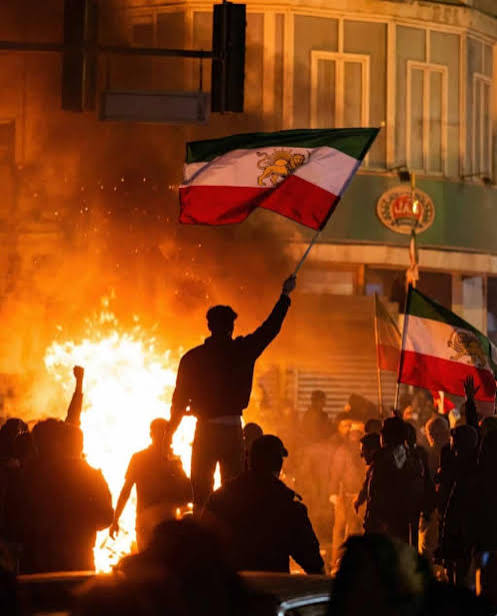
“Death to the Dictator!”
“Death to Khamenei!”
“This is the final battle! Pahlavi will return!”
“Neither Gaza nor Lebanon, My Life for Iran!”
Those are a sampling of slogans chanted earlier this year during gatherings of Iranian citizens advocating the overthrow of the Islamic Republic of Iran.
(“Pahlavi” refers to Reza Pahlavi, the exiled crown prince of Iran, son of Mohammad Reza Shah Pahlavi, the Shah of Iran who was deposed in 1979 by supporters of what became the Islamist government of Iran today.)
And the gatherings were not small.
Nationwide demonstrations against the government began during the final days of December, 2025, and spread to more than 200 cities across the country. Within days, millions had taken to the streets in protests across all 31 provinces. Iranian security forces gunned down thousands of protesters and arrested thousands more.
By late January of this year, media like Time, The Guardian and Iran International, citing local health officials, reported that between 30,000 and 36,500 protesters were killed over a two-day period.
February saw a second major wave of protests, these at Iranian universities. Government forces held their fire then, and only one student, at the Iran University of Science and Technology in Tehran, died – according to Iranian state media, due to a “sudden health incident.”
But security forces nevertheless searched student dormitories and arrested suspected participants; and volunteer paramilitary militia members physically attacked student protesters.
Even after the U.S. and Israel launched attacks on Iran, when a coming together of Iranians to support their government might have been expected, protests continued across Iran, these, largely in the form of nightly rooftop chants from residential buildings. Videos showed security forces firing towards people who were chanting from windows.
It has become hard to deny that the on-again, off-again, bomb again, negotiate again, threaten again U.S. war with Iran is not yielding the goals set forth when the first attacks against the mullocracy unfolded. Nor is it likely that the American public will be willing to back continued war until the Iranian government totally collapses economically. Time is, unfortunately, on Iran’s side.
The solution to the standoff is regime change. And that can only happen when the Iranian populace is able to fight back against the government – and that can happen only when the citizenry is armed.
GAMAAN (a Netherlands-based Group for Analyzing and Measuring Attitudes in Iran) conducted a survey among Iranians and found that roughly 70% to 81% of respondents inside Iran reject the continuation of the Islamic Republic, with support for the ruling system dropping as low as 11%.
Last year, Rouydad24, a reformist news service inside Iran, claimed that its confidential surveys revealed that more than 90% of the population harbors deep dissatisfaction with or outright opposition toward the Supreme Leader and the Islamic Revolutionary Guard Corps (IRGC).
90%.
Whatever the numbers and despite the tens of thousands of anti-regime Iranians who have been murdered or are imprisoned, there can be little doubt that there is a critical mass of Iranians who, if they could, would rise up in revolution.
During the first mass wave of anti-regime protests that swept Iran, President Trump vowed that “help was on the way” and urged protesters to take to the streets and seize institutions. But, after the regime began its crackdown, he opted for the military attack instead.
Then in April, the U.S. attempted to arm Iranians via weapons supplied to Kurdish separatists in Iraq and western Iran. The arms were meant to be passed on to Iranians, but never reached their destined recipients. Mr. Trump said that the Kurds decided to keep them for themselves.
I don’t claim to know if putting boots on the ground is the only way to provide arms to Iranian citizens or if there are less literally invasive means of getting weapons into the right hands.
And no one can know which of the various Iranian factions – monarchists, secularists, Muslim reformists, the Artesh (Iran’s conventional armed forces) – would emerge as controlling a renewed Iran.
But the goals of eliminating Tehran’s ballistic missile infrastructure, halting its nuclear development, and cutting off its support for terrorist proxies will only be even potentially achievable with the removal of the malignant mullahcracy.
© 2026 Ami Magazine