
I wrote a reaction to the NYT”s recent hit job on chassidic yeshivos, for Religion News Service. The piece can be read here.
I wrote a reaction to the NYT”s recent hit job on chassidic yeshivos, for Religion News Service. The piece can be read here.
The horrors of the tochacha, the parsha’s description of what Klal Yisrael will endure should it drift from heeding the Torah, left our ancestors dejected. As Rashi writes at the beginning of parshas Nitzavim (Devarim 29:9), when they heard the 98 curses in our parshah, in addition to the 48 in parshas Bichukosai, “their faces paled” and they said, “who can possibly persevere through this?”
Significantly, in the yearly Torah reading cycle, these parashos coincide with Elul’s march toward the Yimei Hadin. And despondence this time of year is a seasonal affliction.
We, too, can feel dejected as Rosh Hashanah comes close, as we will be judged on things that we repented for last year but may need to do the same once again.
But feeling despondent is counterproductive.
The late comedian Mitch Hedberg would deadpan: “I used to do drugs.” And then, after a short pause, add: “I still do. But I used to, too.”
The line may have been a throw-away absurdity. But I think he was describing how he had once (perhaps more than once) quit drugs, only to come to re-embrace them. When he was clean, he “used to do drugs”; now, off the wagon, he does them again.
Many of us can relate, having resolved each year to improve in some of the very same ways we had resolved to improve the year before. We “used to” do things that we currently do too.
In a famous letter, Rav Yitzchok Hutner, zt”l, told a despondent student to realize that one can “lose battles but win wars,” that what makes life meaningful is not beatific basking in the sublime company of one’s accomplishments but rather in one’s dynamic struggles.
Shlomo Hamelech’s maxim that “Seven times does the righteous one fall and get up” (Mishlei, 24:16), Rav Hutner continues, does not mean that “even after falling seven times, the righteous one manages to gets up again” but, rather, that it is only and through repeated falls that a person achieves. The struggles – even the failures – are inherent elements of what can, with determination and perseverance, become an ultimate victory.
Facing our mistakes squarely, and feeling the regret that is the bedrock of repentance, is essential. But it carries a risk: despondence born of battles lost. But the war is not over. We must pick ourselves up. Again. And, if need be, again.
And, as to the curses in the parsha, as Moshe reassured the people (see Rashi, Devarim 29:9), despite all the past and possible future failures, “You are still standing.”
© 2022 Rabbi Avi Shafran
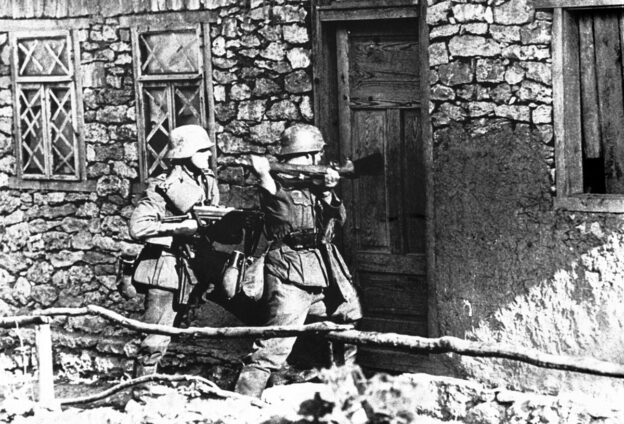
Think you’re smart? Well, let’s see. Can you spot the pattern in these quotes from public servants and other personalities about the FBI raid on former President Donald Trump’s Mar-a-Lago Club and the seizing of government documents therefrom?
Here goes:
Florida Senator Rick Scott: “The way our federal government has gone, it’s like what we have thought about the Gestapo…”
Arizona Representative Paul Gosar: “I will support a complete dismantling and elimination of the Democrat brown shirts known as the FBI.”
Florida Congressional candidate Lavern Spicer: “Biden’s FBI is no better than Hitler’s Gestapo…”
California Representative Mike Garcia: “This is literally tyranny of a majority right now that is acting more like a Third Reich than they are the United States…”
Colorado Representative Lauren Boebert: “Gestapo [expletive deleted].”
Former deputy assistant to the former president Sebastian Gorka: “A hatchet job that is Gestapo Stasi tactics.”
Former Trump White House strategist Steve Bannon: “[The FBI], the jackbooted American Gestapo, essentially kicked down the doors at Mar-a-Lago.”
Newsmax TV host and columnist Benny Johnson: “We live under a morally repugnant Gestapo regime.”
Member of the former president’s legal team Rudy Giuliani: “Big stormtroopers coming in and breaking down his apartment and breaking down his office.”
You did it! Congratulations! (Well, Mr. Gorka at least added the communist “Stasi” to his Nazi reference.)
Whatever one might feel about the FBI raid on Mr. Trump’s club and residence, though, whether one feels it was a responsible and necessary enforcement of the law or an unwarranted persecution of a reviled enemy, one thing it wasn’t was the equivalent on any level of the Nazis’ brutal treatment and terrorization of Jews and others before and during the Second World War.
There can be no denying that Mr. Trump is deeply disliked by Democrats, or that he has been subject to an inordinate number of investigations, including two impeachments. And no denying that insinuations that he intended to sell state secrets to highest-bidder foreign entities are wild and pernicious speculations.
But no denying, either, that, after a judge weighed evidence and issued a search warrant, 33 boxes of documents belonging to the government, including some 100 highly classified ones, were found in the former president’s Florida home. Even after Mr. Trump’s lawyers claimed that all such material had been returned to the National Archives.
And no denying that no one tortured or beat Mr. Trump (at least not literally) and no one seized him and sent him to a concentration camp. And that Mar-a-Lago isn’t quite the Frank family secret annex.
As one social media commentator, Tim Byers, responding on Twitter to Ms. Spicer, put it: “Yep. Retrieving stolen classified documents is exactly like executing millions of Jews. Congratulations, you nailed the comparison.”
Invoking Nazi nomenclature isn’t even limited to supporters of the former president. The man who bested him in the 2020 election, President Biden, recently decried the “extreme MAGA philosophy” to a group of donors, and went on, gingerly but strikingly, to say: “It’s not just Trump. It’s the entire philosophy… It’s like semi-fascism.”
Okay, not all fascists are Nazis, and the Nazis weren’t exactly “semi” anything. But still.
There may actually be something positive to note – at least for the incurably starry-eyed among us – about all the Third Reich comparisons. Namely, that those seeking to utterly vilify their opponents, grasping for the very worst insult they can find, end up choosing Third Reich-flavored slurs.
But the bottom line, for the sake of history if nothing else, has to be that such overheated rhetoric insults the memory of those who suffered things immeasurably worse than a legally justified pursuit of evidence in the investigation of a crime – or a politically motivated attempt to harass a loathed enemy – whatever your preferred description.
With fewer human links than ever to the events of 1933-1945 in Europe and increasing attempts by true enemies of truth to deny essential facts about those years, it is especially urgent these days to not cheapen words and phrases like “Gestapo,” “storm troopers” and “fascism.”
Because they all have meanings, all-too-real ones.

You’ve likely met some members of the infraorder Fulgoromorpha (in, of course, the suborder Auchenorrhyncha). That is to say: lanternflies.
What to do about it, considering the damage it stands accused of causing? Well, you can read an answer here.

A rather stark contradiction seems to lie in how Chazal describe the judgment meted out to a ben sorer u’moreh, the boy who, at the tender age of 13, demonstrates indulgences and worse, and how they treat Yishmael.
The former is judged al sheim sofo, based on what his “end” will likely be: a murderous mugger (Devarim 21:18). The latter, although his descendants will prove to be cruel tormenters of his half-brother Yitzchak’s descendants, is judged “ba’asher hu shom”: where he is at the current moment (Beraishis 21:17).
Granted, the case of a ben sorer u’moreh is virtually impossible to happen, given Chazal’s requirements for prosecution (see Sanhedrin 71a), and, according to Rabi Yehudah, indeed never did. But the explanation of the boy’s irredeemability is at least intended as a lesson, and still clashes fundamentally with the allowance Yishmael is given to become a better person (and, presumably, influence his progeny to follow him in that).
The Mizrachi and Rav Shlomo Zevin address the problem by noting that the ben sorer u’moreh has already himself acted in an ugly manner, whereas Yishmael’s cruel descendants lay generations in the future.
But that ignores the fact that Chazal describe Yishmael himself as having already demonstrated bad behavior, including, according to one opinion, shooting arrows at his half-brother (Rashi, Beraishis 21:9).
What occurs is the possibility that such behavior is only bad when unbridled. One can pull the yetzer hara into the beis medrash (Kiddushin, 30b), channeling it to good effect. And the urge to “violence” can be expressed in milchamta shel Torah, the “warring” of arguments between Torah scholars, lisheim Shomayim.
But, by contrast, the mire of materialism – virtual addiction to luxuries – has no redeeming value. And the young boy sufficiently sunken in it is hopeless.
Which, if true, offers a vital lesson to parents: Be less alarmed by a child’s propensity to bad behavior and violence than to his growing addiction to luxuries. And be very careful not to create, cultivate or feed that fixation.
© 2022 Rabbi Avi Shafran

The belief that Jews are cheap has merit, though “frugal” would be the more perceptive word. Valuing everything, no matter how small or seemingly trivial, is a fundamental Jewish ideal.
My parents rinsed and reused plastic cups and refrigerated even small amounts of a meal’s leftovers rather than consigning them to the garbage. My mother darned holey socks instead of tossing them. That wasn’t cheapness, it was Jewishness. And the placing of even pennies in a pushke was, and is, the fulfillment of a mitzvah.
We live at a time and in a society that sees so much of value as disposable. That attitude is among the many contemporary ones we Jews are meant to struggle against.
There are certainly people who are stingy for selfish reasons, but focused frugality bespeaks an appreciation of the worth of every single resource with which Hashem has gifted us.
The Sefer HaChinuch (mitzvah 529, commenting on a pasuk in parshas Shoftim) explains that the prohibition of gratuitously cutting down a fruit tree telegraphs a larger lesson, that of the general forbiddance of bal tashchis, wastage.
It aims to “teach our souls to love what is good and useful, and to then cleave to it,” adding that “through this, the good will cleave to us and we will distance ourselves from every evil thing and every destruction. This is the way of exemplary Jews…
“They do not destroy anything – even a mustard seed – and it pains them to encounter any destruction or harm. If they can act to save anything from destruction, they use all their strength to do so.”
“Not so,” he adds by contrast, is the way of “evil people… the cohorts of destructive forces, who rejoice in destroying the world.”
That attitudinal polarization is well evident in our world. Broken windows, smashed bottles and graffiti-marred walls, not to mention assaults and murders, are the yield of one end of the spectrum.
And rinsed-out plastic cups in dish drainers, with filled-to-their-brims-with-pennies-and-nickels tzedakah boxes on nearby kitchen window sills, the other.
© 2022 Rabbi Avi Shafran

An old piece with a connection to Rosh Chodesh can be read here.

Good news for ears has come down the pike. And it raises a good question that isn’t often raised but should be.
To read what happened and what I mean, please click here.
Fact-free fantasies are all the rage
Shameless charlatans and flagrant fabulists are nothing new. But they seem to be proliferating rather wildly these days.
In only the latest of a slew of recent such scams, a man was just sentenced to five years in prison after raising $400,000 in a GoFundMe campaign, ostensibly for a homeless veteran. He and his companion spent much of the money on gambling, a BMW, a trip to Las Vegas, a helicopter ride over the Grand Canyon and designer handbags.
Then there’s Alex Jones, the conspiracy theorist radio host and operator of the website InfoWars, who, after a Texas jury’s ruling this month, must pay $45.2 million in punitive damages, in addition to $4.1 million in compensatory ones for spreading the lie that the 2012 Sandy Hook Elementary School shooting was a hoax “staged” by the government so it could “go after our guns,” and that none of the 20 children killed in that attack had actually died.
He called those all-too-real childrens’ parents, who had to identify and bury the bullet-riddled bodies of their young ones, “crisis actors,” resulting in their being retraumatized, and harassed and hounded by some of Jones’ faithful followers.
Previously, the popular fabler endorsed the “Pizzagate theory”—that Democratic Party operatives ran a global child-trafficking ring out of a DC pizzeria—and implied that a yogurt company was linked to an assault case and helped spread tuberculosis, both of which fact-free fantasies he was later forced to apologize for promoting.
Apparently inspired by Mr. Jones, Georgia Representative Marjorie Taylor Greene suggested that the man who opened fire on a Fourth of July parade in Highland Park, Illinois, this year, killing six, might have been part of an orchestrated effort to persuade Republicans to support gun control measures.
Millions of Americans believe, without evidence, that the 2020 presidential election was “stolen”; and millions, too (though there’s likely considerable overlap), that the 9/11 attacks were perpetrated by US government agents. Among the latter group is Michael Peroutka, the Republican Party nominee for Maryland attorney general.
According to a new study by UNESCO, approximately half the public content related to the Holocaust on the Telegram messaging service denies or distorts facts about the extermination of millions of Europe’s Jews.
And, with each year leaving us with fewer human witnesses to that evil, the noxious weeds of Holocaust denial are bound to infest the history garden.
Poised, too, to become a powerful engine further impelling our era of lies are “deepfakes.”
Those are videos produced with special software that makes it seem that an identifiable person is saying or doing something he or she has, well, neither said nor done. Photoshop on steroids.
The software, readily available and being constantly refined, can alter the words or gestures of a politician or other public figure, yielding the very fakest of fake news.
In 2019, Senator Marco Rubio, a member of the Senate Intelligence Committee, warned that “America’s enemies are already using fake images to sow discontent and divide us. Now imagine the power of a video that appears to show stolen ballots, salacious comments from a political leader, or innocent civilians killed in conflict abroad.”
According to a report released last week by technology company VMware, attacks using face- and voice-altering technology jumped 13% last year.
“Deepfakes in cyberattacks aren’t coming,” the company’s Rick McElroy said in a statement. “They’re already here.”
In March, for one example, a video posted to social media appeared to show Ukrainian President Volodymyr Zelensky directing his soldiers to surrender to Russian forces. It was a deepfake.
The 24-hour news cycle and expansion of social media platforms only compound the problem. “A lie,” as the saying often attributed to Mark Twain goes, “can travel halfway around the world while the truth is still putting on its shoes.” Today, it’s gone all the way around the world before truth even finds its shoes.
So there is ample cause for despair. Lies upon lies exposed, many more still claiming the gullible and a likely empowering of falsehood-promotion in the not-distant future.
But cause, too, perhaps, of hope.
Because Chazal (Sotah 49b) foretold that ha’emes tehei ne’ederes, “truth will go missing” one day: When the “footsteps of Moshiach” are approaching.
(c) 2022 Ami Magazine

“Can’t you jus’ see ‘im walkin’ on that water?” an elderly lady with a large hat, standing next to me on the foredeck of the Staten Island ferry and holding a bible, once asked me on a glorious spring day.
“Sure,” I responded with a smile, pretty sure that she had only meant to address someone she saw as a fellow religious person and had no missionary goal.
The Rambam states that “miracles” prove nothing. They can be sleights of hand, optical illusions or actual magic. He explains that all the miracles our ancestors experienced in Egypt and the desert were divine ways of addressing their needs, not intended as “proofs” that Hashem was behind them. Only the actual and direct interaction with Him at Har Sinai cemented Klal Yisrael’s belief in Hashem and Moshe’s reliability.
Which is why the performance of a wonder cannot, at least alone, establish a prophet’s credentials. In fact, as our parsha notes, a self-proclaimed prophet’s miracle can be totally meaningless.
“If there appears in your midst a prophet or a dream-diviner, who gives you a sign or a portent, saying, ‘Let us follow and worship another power’… and the sign or portent comes true, do not heed the words of that prophet or that dream-diviner. For Hashem is testing you… (Devarim 13:2-4).
In fact, when I was once asked by an actual missionary whether I knew that Christianity’s object of veneration is hinted at in the Torah (with the questioner ready, I knew, to offer mistranslated and misinterpreted pesukim in Yeshayahu), I readily answered yes. And pointed out the pasuk above – and the one immediately preceding it: “Be careful to observe only that which I enjoin upon you: neither add to it nor take away from it” (13:1).
In fact, the Baal HaTurim, in non-censored editions, offers a poignant gematria. The numerical value of the phrase “in your midst,” he notes, equals that of the phrase “this is the woman.” And that of “prophet,” the next word, “and her son.”
© 2022 Rabbi Avi Shafran